
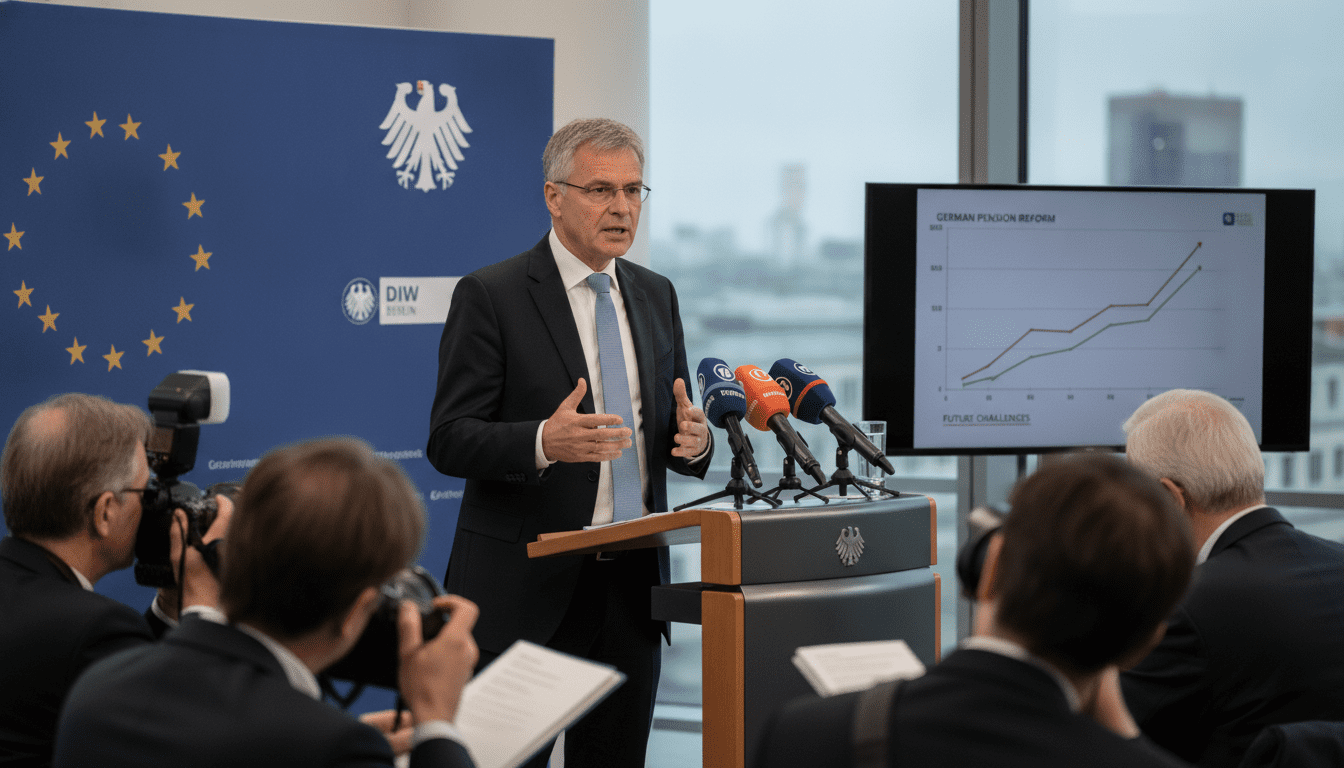
Germany Pension Commission Draws Criticism from DIW President Marcel Fratzscher
Germany’s pension commission proposals drew sharp critique from DIW president Marcel Fratzscher, who said the pension commission’s package is too cautious to secure long-term retirement stability.
Marcel Fratzscher, head of the German Institute for Economic Research (DIW), told the Rheinische Post that the pension commission’s recommendations move in the right direction but “lack courage and consequence,” arguing they will not decisively stabilize statutory pensions. He singled out persistent old‑age poverty, an unequal burden on younger generations, and fairness distortions as problems left fundamentally unaddressed by the pension commission’s draft proposals.
Fratzscher says proposals too cautious
Fratzscher praised individual elements of the pension commission’s work but warned that incrementalism will not solve structural problems in Germany’s retirement system. He highlighted proposals such as a higher retirement age, a capital‑funded supplementary pillar, and measures to reduce early retirement as sensible, yet insufficient on their own.
The economist pressed the government to convert the commission’s recommendations into bolder policy, saying political decisions must go beyond the report to strengthen the basic pension, better shield low pensions from poverty, and make financing more sustainable over decades.
Commission recommends raising retirement age to 70
Among the headline measures reported from commission deliberations is a gradual framework for increasing the statutory retirement age toward 70, with implementation horizons reaching later in the century. The pension commission has signaled that the baseline age could be indexed to rising life expectancy and moved substantially upward over time.
The proposal to phase in a higher retirement age formed part of a broader set of systemic adjustments intended to reduce pay‑as‑you‑go pressures. Fratzscher acknowledged the logic of aligning retirement age with longevity but argued such moves must be paired with targeted protections for those in physically demanding jobs and groups with shorter life expectancies.
Plans to widen contribution base to include new groups
The pension commission has also recommended broadening the contribution base by bringing additional groups into the statutory system, including self‑employed workers, civil servants, and members of parliament. The proposal would end exemption privileges for some groups and expand coverage to reduce distortions and increase revenues.
A further recommendation reportedly targets the abolition of contribution exemptions for mini‑jobs, aiming to make low‑paid employment more integrated with social protection. Advocates say these steps would enhance fairness and long‑term financing, while critics caution that sudden changes could increase costs for certain professions and small businesses.
Capital‑funded pillar and limits on early retirement
Another central element is the introduction of a capital‑funded supplementary pension modeled on frameworks used in Sweden, designed to supplement the statutory pay‑as‑you‑go system. The pension commission envisions a mixed approach that preserves a core public pension while creating a funded tier to share risk and potentially boost returns for future retirees.
The commission also recommends curbing unpenalized early retirement pathways, including changes to the practice of taking full pension at 63 without reductions. These measures aim to discourage premature exits from the labor force and improve contribution timelines, though they raise questions about labor market capacity and social acceptance.
Political responsibility now falls to the federal government
The pension commission produces advice; implementation hinges on political choices that will fall to the federal government and parliament. Fratzscher emphasized that many of the proposals require legislative follow‑through and fiscal design choices that determine who gains and who bears the cost.
Lawmakers will have to weigh trade‑offs between immediate fiscal relief, intergenerational equity, and social solidarity. The coming weeks are likely to feature heated debate in party caucuses, unions, employer associations, and among pensioner groups as the government translates the pension commission’s recommendations into concrete reform bills.
The commission’s report combines measures meant to shore up sustainability with proposals to improve fairness across income groups, but the DIW president and other observers warn that incremental steps without targeted anti‑poverty protections will leave significant risks unaddressed.
