
Relativity Space Wins NASA Contract to Build Aeolus Mars Orbiter, Targeting 2028 Launch
NASA hires Relativity Space to build and launch Aeolus to Mars in 2028, aiming to deliver daily global maps of dust, winds and temperature for future missions.
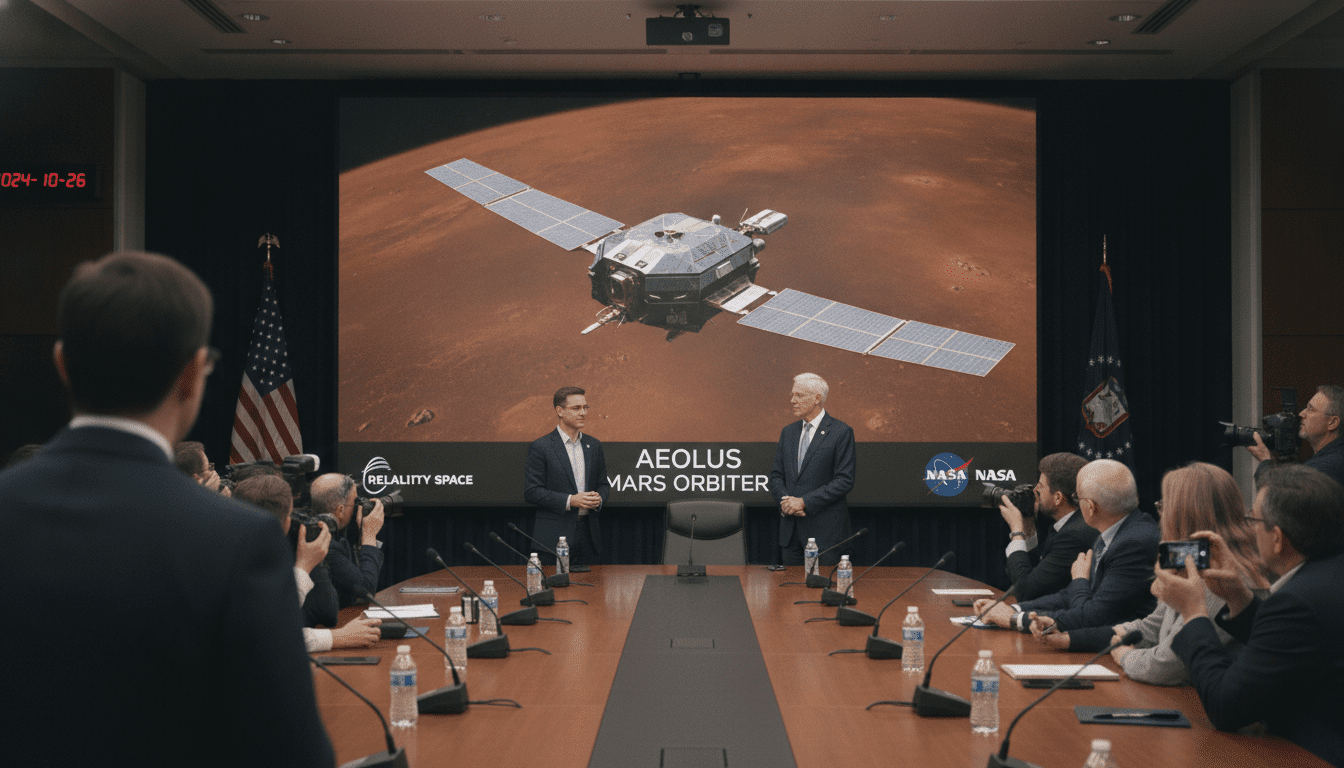
Relativity Space has been awarded a NASA contract to design, build and launch the Aeolus spacecraft to Mars, a private-led effort that could deliver the first daily, global observations of Martian dust, winds and atmospheric temperature. The company will supply the spacecraft and launch services while NASA provides the science instruments and mission direction, setting a rapid 2028 timetable for departure. If successful, the Aeolus project would mark a significant step for commercial participation in deep-space science and could become the first privately developed mission to reach Mars.
NASA awards Relativity Space Mars orbiter contract
NASA said it has contracted a commercial partner to provide end-to-end mission hardware and launch capabilities for an orbital science mission to Mars. The agency will supply a suite of four instruments to be integrated into the spacecraft built by Relativity Space. The arrangement mirrors recent public-private models where NASA supplies scientific payloads and commercial firms deliver vehicles and launch infrastructure.
Instruments to map dust, winds and temperature
Aeolus will carry four instruments designed to produce daily, planet-wide measurements of atmospheric dust, wind patterns and temperature structure. NASA expects the data to improve weather forecasting for landers and to support long-term planning for crewed missions by reducing surface-entry risk. The mission aims to deliver continuous global coverage that current orbiters and ground assets do not provide on a daily cadence.
Contract structure and compressed 2028 timeline
Under the contract, Relativity Space will assume responsibility for spacecraft design, integration and launch services while NASA funds and manages the instruments and science operations. The target launch window in 2028 imposes a tight schedule that requires concurrent progress on both the spacecraft and the company’s next-generation rocket. NASA did not disclose contract value and Relativity Space has not publicly released financial terms for the award.
Relativity’s development history and Terran R ambitions
Relativity Space, founded in 2015 by former engineers from major aerospace firms, pioneered heavy use of large-scale 3D printing as a route to lower-cost rockets. Its first vehicle, Terran-1, reached flight in 2023 but did not complete its orbital ascent, after which the company pivoted to an enlarged reusable design called Terran R. The Aeolus award will require Relativity to accelerate final development and testing of its launch vehicle alongside spacecraft production to meet the 2028 mandate.
Eric Schmidt’s investment and commercial strategy
The company’s ownership has shifted in recent months following a major investment by former tech executive Eric Schmidt and associated family philanthropy. That backing has been framed as part of a broader commercial plan that includes potential customers for launch services, orbital data platforms and privately financed science missions. Observers see the NASA contract as both a revenue and credibility boost that could help Relativity open additional commercial markets if the vehicle and mission perform as planned.
Risks inherent in a private-led Mars mission
NASA’s approach transfers development costs and some technical risk to the commercial partner, but it does not remove programmatic uncertainty for the agency. Relativity remains unproven at the scale of a deep-space mission and the Terran R rocket must demonstrate reliability before a Mars injection attempt. The history of small aerospace firms shows the sector’s volatility; a high-profile prize like Aeolus carries potential upside but also the possibility of delay or failure.
Implications for the race to Mars and commercial spaceflight
If Aeolus launches and reaches Mars as scheduled, it could be the first private mission to deliver sustained science from the Red Planet, changing perceptions about who can mount planetary exploration. The mission also highlights a shifting model in which NASA leverages private capital and engineering to expand science delivery within constrained budgets. Competitors and established providers will watch Aeolus closely for both technical lessons and market signals about demand for commercial deep-space services.
The Aeolus contract places Relativity Space at the center of a fast-moving experiment in public-private exploration, coupling NASA science goals with commercial manufacturing and launch ambitions. Success would add a new capability for Martian atmospheric monitoring and validate a partnership model that the agency has used increasingly in lunar and Earth-orbit programs. Failure or delay would complicate near-term plans but would also provide hard lessons for the integration of nascent launch providers into planetary exploration.
