
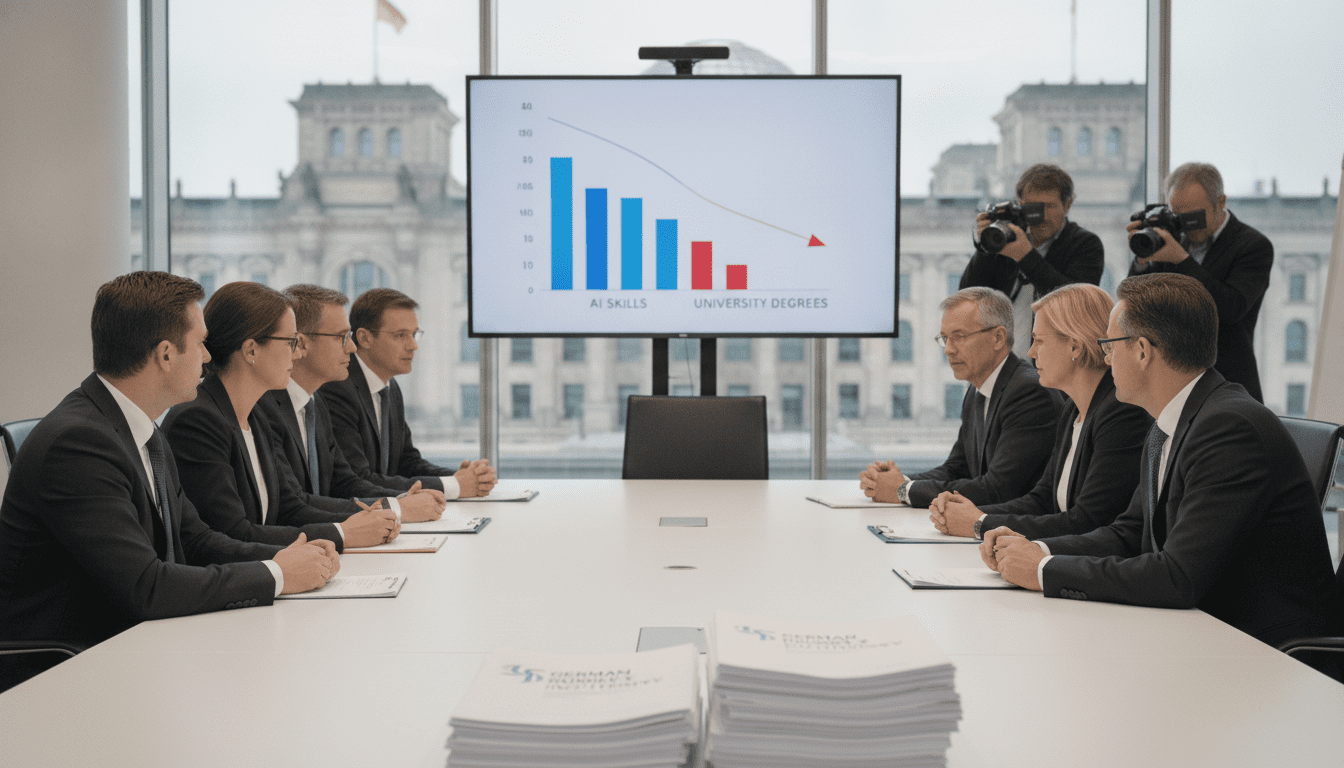
AI skills trump university degrees, Ifo survey shows
Companies report AI skills can replace formal qualifications, but most remain cautious about substituting experience for AI-assisted hires. (155 characters)
A new Ifo Institute survey shows growing employer belief that AI skills can substitute for formal qualifications, with nearly 20 percent of AI-using firms saying it is easy to replace university graduates with less-qualified, AI-assisted staff. The finding, reported by Reuters and released Friday, also found about 15 percent of those firms think experienced workers can be replaced by inexperienced employees who use AI. At the same time, a majority of companies say replacing graduates or seasoned staff with AI-supported hires would be difficult or impossible.
Ifo survey headline figures on AI skills and hiring
The Ifo Institute asked firms that already deploy AI about the ease of replacing different types of workers with staff who rely on AI tools. Roughly 54.5 percent of German companies said they use AI in business processes, and within that group attitudes about replacement varied sharply. Nearly 20 percent judged it “easy” or “very easy” to supplant university-educated employees with less-qualified, AI-assisted workers, while about 15 percent saw the same possibility for replacing experienced staff.
Ifo researcher Anna Ruffert summarized the finding by saying AI is changing the workplace and in some areas can partially substitute for formal qualifications and experience. The institute published the results on a Friday, underlining that the shift is still uneven across sectors and tasks where machine assistance is more or less applicable.
Retail sector most open to AI skills replacing degrees
The willingness to replace formal qualifications with AI-assisted hires is strongest in the retail sector, where 28.6 percent of companies reported it would be easy to substitute graduates with AI-supported staff. Service firms follow with 19.7 percent, while the manufacturing sector reports a lower rate at 14.6 percent. These differences point to sector-specific task structures and the relative standardization of roles that make automation more feasible in some industries.
Retail tasks often involve repeatable customer interactions, inventory decisions and standardized sales processes that can be augmented by AI tools, analysts say. That makes “AI skills” — the ability to use and interpret machine outputs — particularly valuable in retail, where firms can gain efficiency by retraining or hiring staff who are adept with AI-assisted workflows.
Experience harder to replace than formal education
Survey respondents were more skeptical about substituting experience with AI-enabled newcomers. A larger share — 62.7 percent of firms using AI — said it would be hard or impossible to replace experienced employees with inexperienced, AI-using staff. The gap between substituting qualifications and substituting experience suggests companies still value tacit knowledge, judgment and institutional memory that AI cannot easily replicate.
Experts note that experience often embeds context-sensitive decision-making, client relationships and troubleshooting skills developed on the job. While AI can support decision processes, those human capacities remain important for managing exceptions, complex negotiations and tasks that require deep sector knowledge.
Majority of firms remain cautious despite optimism
Although a notable minority of companies sees AI skills as a pathway to reduce formal qualification requirements, the overall picture is cautious. More than half — 55.4 percent — of AI-using firms consider replacing university graduates with less-qualified, AI-assisted workers to be difficult or not possible. That majority view indicates firms expect limits to what AI can substitute and suggests many employers will continue to prize formal credentials in hiring decisions.
The mixed assessments also reflect practical concerns such as regulatory risk, product quality, customer trust and the complexity of integrating AI into workflows. Firms that see potential for replacement are likely focusing on specific functions with clear rules and metrics, while those that resist change point to roles where human discretion and experience dominate.
Implications for hiring, training and workplace policy
The Ifo findings carry immediate implications for human resources, workforce development and public policy. Employers may shift hiring toward candidates with demonstrable AI skills, combining technical literacy with domain knowledge, rather than relying solely on formal degrees. That could raise demand for targeted training and short-cycle credentials that certify AI competence in specific tasks.
Policymakers and training providers will face pressure to expand reskilling programs so workers can develop AI skills that complement rather than simply replace experience. Labor-market impacts may be uneven: roles with standardized tasks could see quicker change, while occupations that require hands-on judgement and long-term client relationships may remain resilient.
The results also prompt questions about equity and credentialing. If firms begin to prefer AI-savvy candidates over degree holders in some roles, the pathways into stable employment may shift. Social safeguards, transitional supports and clear standards for AI-augmented work will be important to manage dislocation and ensure quality and accountability in services that rely on AI-supported personnel.
As AI tools become more widespread, companies will need clearer frameworks to decide when AI skills can legitimately substitute for qualifications and when human experience remains indispensable. The Ifo survey highlights both the potential and the limits of that transition in the German labor market.
The Ifo data underline a cautious but consequential change: AI skills are increasingly valued and in some contexts can reduce the premium on formal degrees, yet most firms still view experience and certain human capabilities as difficult to replace.
