
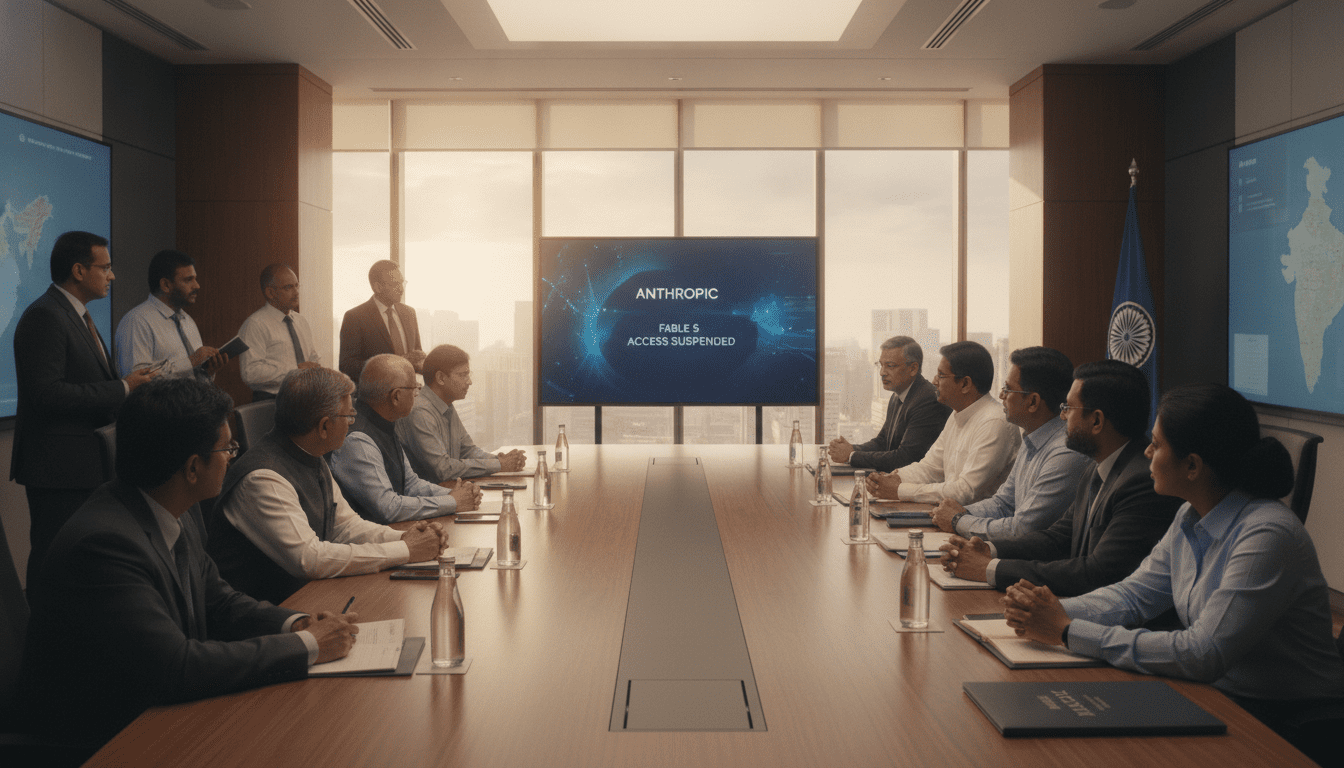
Anthropic suspension of Fable 5 prompts Indian push for sovereign AI
Anthropic suspension of Fable 5 and Mythos 5 on June 12, 2026 has reignited debate in India over reliance on U.S. frontier AI providers and accelerated calls for domestic capabilities.
U.S. directive halts foreign access to Fable 5 and Mythos 5
Anthropic said on June 12, 2026 it received a U.S. government directive requiring the company to suspend access to its newest models, Fable 5 and Mythos 5, for non-U.S. nationals, including foreign national employees. The move immediately curtailed access for users and partners outside the United States and prompted questions about operational continuity for international customers.
Some reports attributed initial security concerns to private escalation within the U.S. technology sector, a claim Anthropic has disputed while arguing the directive was unwarranted. Regardless of the underlying cause, the action has become a flashpoint in discussions about who controls access to frontier AI capabilities.
Indian founders and investors call for accelerated domestic AI
Across India’s startup and investor community, the suspension was widely interpreted as proof that dependence on a small number of foreign model providers carries strategic risk. Several founders and venture investors said the episode strengthened their resolve to accelerate development of locally controlled models and infrastructure.
Voices from the sector urged a reassessment of procurement and product road maps to reduce single-vendor exposure. For many, the immediate priority is ensuring that critical development and deployment pipelines are resilient to sudden changes in provider access or export controls.
Startups weigh open-source and hybrid model strategies
The announcement has prompted startups to revisit model strategies, with many expressing renewed interest in open-source alternatives and hybrid architectures that combine local models with selective cloud-hosted capabilities. Developers and product teams described plans to evaluate smaller, composable models and to invest in tooling that makes switching providers less disruptive.
Firms that operate cross-border engineering teams flagged a practical problem: differential access to frontier models can produce uneven competitive advantages. Several founders said they will prioritize models and platforms that permit consistent access for distributed teams in order to avoid future operational bottlenecks.
Policy proposals and calls for large-scale funding
Policy experts and some investors called on New Delhi to respond with a more ambitious national AI agenda. Proposals under discussion include major public funds to underwrite compute capacity, incentives for semiconductor and cloud infrastructure, and credit schemes to lower the cost of training and hosting large models in India.
Those advocating for large-scale intervention argue that incremental measures will not be sufficient to close the gap with frontier providers. Skeptics note that funding alone will not guarantee success, and emphasize that talent, partnerships, and execution capacity must scale in parallel.
Talent dynamics and the future of outsourcing
Industry leaders warned the episode could accelerate shifts in how multinational firms structure engineering teams and outsourcing partnerships. Some companies are already re-evaluating the geography of operational roles as AI reduces the need for large offshore delivery teams in certain domains.
At the same time, others suggested AI could create new high-value roles in India tied to data, productization, and domain-specific customization. The net effect on employment and outsourcing will depend on whether Indian companies and policy makers can capture the higher-value layers of an AI-driven stack.
Strategic autonomy and geopolitical implications
Technology policy observers framed the suspension as a reminder that foreign AI models remain subject to the geopolitics of their home jurisdictions. That reality, they said, makes strategic autonomy a central concern for countries that rely on external providers for critical AI infrastructure.
Some experts compared the situation to earlier disruptions in global systems that prompted national investment in alternatives. For Indian officials, the episode is likely to sharpen debates on export controls, data governance, and incentives for indigenous model development.
India’s technology ecosystem now faces a complex calculus: maintain deep commercial ties with U.S. frontier providers that offer advanced capabilities today, or divert resources to build homegrown models and infrastructure that reduce geopolitical exposure tomorrow. The balance between immediate productivity gains and long-term strategic independence will shape policy choices, investment flows, and product road maps in the months ahead.
The Anthropic suspension has already altered boardroom and government conversations, and its reverberations are likely to influence where Indian startups place their bets on models, data sovereignty, and compute capacity.
