
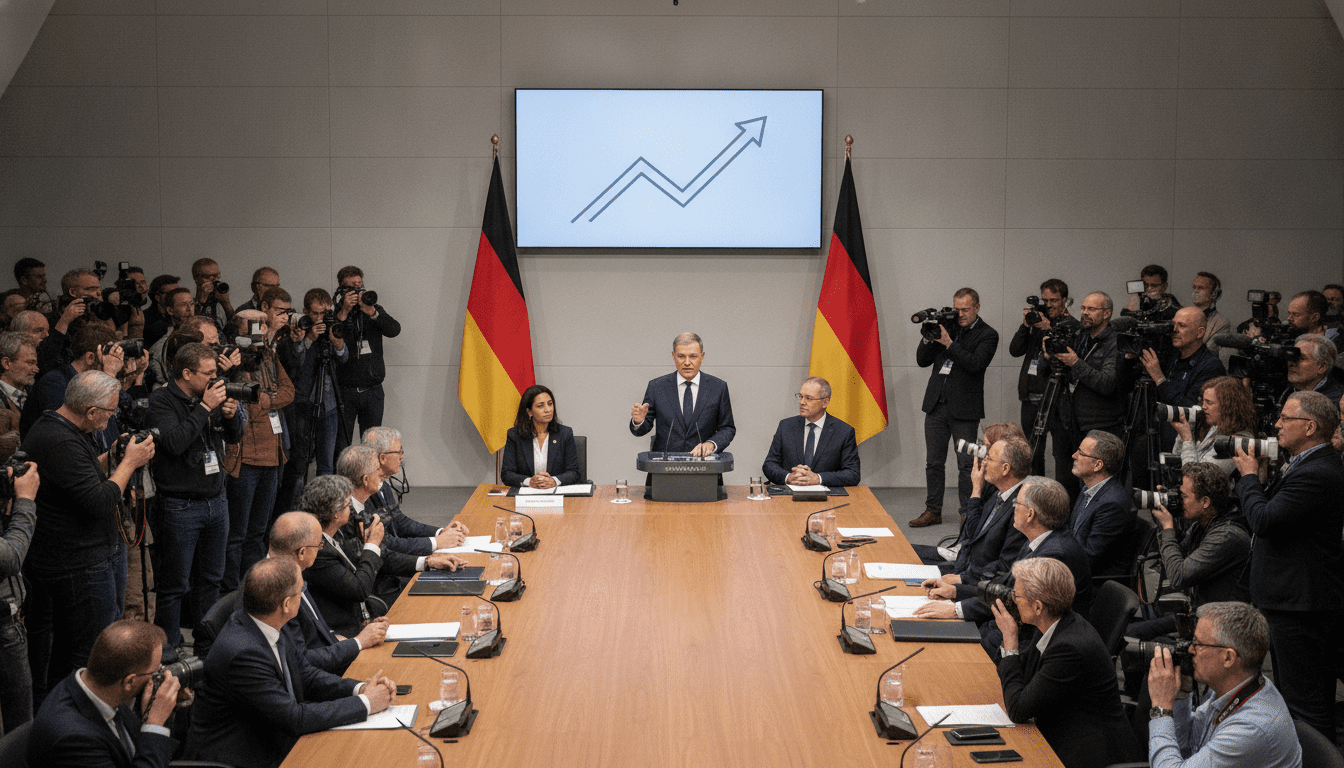
Germany competitiveness summit: Chancellor meets unions and employers to plot reforms
Germany competitiveness summit at the Chancellery unites coalition, unions and employers to map reforms on growth, social insurance, bureaucracy and taxes.
The Germany competitiveness summit at the Chancellery brought top coalition leaders together with major employer associations and trade unions for a three-and-a-half-hour discussion on measures to bolster growth and employment. Government spokesman Stefan Kornelius said participants exchanged views on “necessary reform steps for growth and employment,” and agreed to pursue changes intended to strengthen Germany’s economic position. Chancellor Friedrich Merz framed the talks as a dialogue to restore competitiveness and make progress on immediate priorities for the coming weeks.
Summit duration and setting
The meeting took place in the Kanzleramt and lasted roughly three and a half hours, according to participants. Officials described the atmosphere as concentrated and constructive, centred on finding common ground between political leaders and social partners. The gathering was convened to translate political positions into concrete options for policy action.
Who sat at the table
Representatives from the governing CDU, CSU and SPD joined the heads of Germany’s main employer associations — BDI, DIHK, BDA and ZDH — alongside trade-union leaders from the DGB, IG Metall, IG BCE and Verdi. That mix reflected an explicit intent to align perspectives from business, labour and government before formal decisions. Participants are influential voices for both industry competitiveness and workers’ rights, giving the meeting extra political weight.
Four priority policy fields discussed
Participants focused their exchanges on four core areas: the labour market, the stability and financing of social insurance systems, bureaucracy reduction and tax policy. Each field was discussed in the context of how to boost employment, shore up fiscal sustainability and ease burdens on companies and households. Government spokespeople said the debate touched on concrete levers rather than abstract principles.
Agreement on social-system reform and bureaucracy cuts
All sides acknowledged that Germany’s social systems require reform and that administrative burdens should be reduced to improve efficiency. Kornelius said employer and union representatives indicated a willingness to “constructively accompany” a reform process, signaling an unusual degree of alignment between traditionally adversarial partners. That consensus, officials emphasized, does not equate to settled policy but opens space for detailed negotiations.
Competitiveness goals and policy levers named
Chancellor Merz used the meeting to underline competitiveness as the central aim, writing on X that “good solutions arise in dialogue.” Government officials identified lowering energy costs and targeted tax relief for employees as concrete measures that could help make the economy more attractive and competitive. Those proposals will have to be reconciled with fiscal rules and social insurance financing, which were also focal points of the discussion.
Next steps and decision timetable
Participants agreed to continue talks, and further meetings were scheduled to work through specifics and trade-offs. Employers and unions said they would likely make public statements the day after the meeting, while the coalition plans to take decisions on the proposed reforms at a coalition committee meeting on July 1. Officials framed that timetable as ambitious but necessary to move policy from talk to implementable steps.
Germany faces what participants described as a mix of technological shifts, demographic pressures and a series of international crises that together have heightened the urgency for reform. Those structural challenges were cited repeatedly during the summit as reasons why quicker action is needed to secure jobs and maintain the country’s industrial base. The dialogue produced a shared acknowledgment that preserving employment and improving the business environment require coordinated measures across taxation, energy policy and regulatory simplification.
The extent to which unions and employers will accept compromise on contentious items — such as contributions to social insurance or specific tax measures — remains to be seen, and negotiators warned that technical work is needed to assess fiscal impacts. Officials said the coming sessions will focus on concrete savings, incentive designs and timelines for implementing changes. If the coalition follows through on the July 1 milestone, draft proposals could be ready for parliamentary consideration in the weeks that follow.
Observers noted that the summit’s most immediate value may be political: demonstrating a cross-sector willingness to engage on reform can lower uncertainty for businesses and markets. Yet translating consensus into legislation will test the parties’ ability to balance competing priorities between competitiveness and social protection. The government and social partners will now have to convert the meeting’s constructive tone into measurable policy moves while keeping an eye on social fairness and fiscal sustainability.
Follow-up talks and working groups are expected to produce detailed proposals that will determine whether the Germany competitiveness summit becomes a turning point in the coalition’s economic agenda or a high-level exchange that delays difficult choices. The next round of statements from unions and employers, and the coalition’s internal decisions on July 1, will be the first concrete indicators of how rapidly the proposed reforms will advance.
