
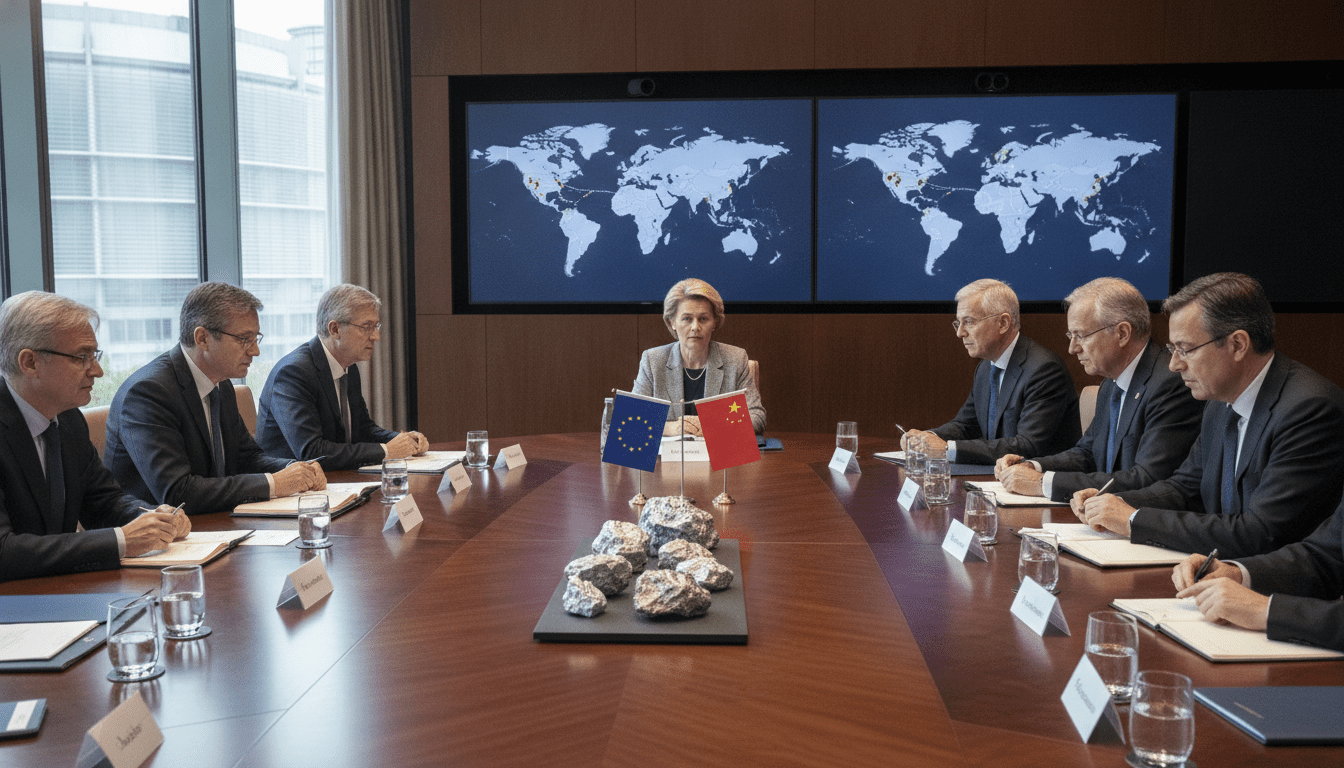
Europe must build a coherent Europe-China strategy to manage leverage and de-risk its dependencies
Stefan Messingschlager urges a Europe-China strategy to counter rare-earth leverage, reduce coercion and strengthen supply resilience.
Europe faces a clear challenge: it lacks a unified Europe-China strategy to manage growing economic and political pressures from Beijing, argues historian and political scientist Stefan Messingschlager of Helmut-Schmidt-Universität in Hamburg. Messingschlager warns that Beijing treats binding commitments as a tactical choice, weighing costs, benefits and control rather than accepting legalistic constraints. His analysis highlights the practical tools China already uses — from export licences to regulatory delays — to protect domestic interests and extend diplomatic influence. Brussels and national capitals now confront the urgent task of transforming rhetorical rules into a strategic policy that reduces vulnerability without severing ties.
Messingschlager’s assessment of Beijing’s calculation
For Chinese leaders, legal commitments are instruments to be managed, not absolutes to be followed at any cost. Messingschlager explains that agreements are embraced when they open markets or stabilise relationships, but they are sidelined when they limit the Communist Party’s freedom of manoeuvre. That approach reframes common European expectations about rules and reciprocity into a transactional calculus aimed at maximising Beijing’s room for action.
This perspective helps explain repeated discrepancies between China’s international pledges and its on-the-ground behaviour. When enforcement threatens domestic control or strategic priorities, Beijing prefers delay, reinterpretation or invocation of security exceptions. Recognising that calculation is central to Chinese decision-making is a precondition for an effective Europe-China strategy.
Export licences and rare earths as diplomatic levers
Messingschlager points to export licences, especially for rare earths, as a prime example of China’s leverage in practice. By controlling permit processes, authorities can slow shipments, prioritise domestic industry or signal political displeasure without a formal embargo. This creates a layer of influence that is hard to counter with standard trade law alone.
The strategic nature of rare earths — essential for batteries, chip production and green technologies — magnifies that leverage for Europe. Dependency in critical materials translates into political vulnerability, and the capacity to withhold or bottleneck supplies becomes an instrument of foreign policy rather than just industrial management.
China’s integrated approach to foreign policy
Chinese foreign policy, Messingschlager argues, is holistic: economic, political and security tools are blended to advance state objectives. Beijing manages dossiers comprehensively, seeking to enlarge its options while constraining rivals’ choices. That means diplomatic outreach, investment strategies and regulatory measures are coordinated to produce long-term influence.
This integrated logic contrasts with parts of Europe’s fragmented response, where single-issue policies fail to anticipate how economic measures can be repurposed for strategic aims. A credible Europe-China strategy must therefore account for interplay across policy domains, not treat trade, investment and diplomacy as separate silos.
Europe’s strategic shortfall and asymmetric dependencies
Many European actors continue to appeal to rules and procedures without building the practical instruments needed to defend their interests. Messingschlager underscores that this gap leaves the continent exposed to asymmetric dependencies that Beijing can exploit. European states may speak in unison about values, yet lack the coordinated industrial and diplomatic tools to respond to coercive tactics.
Addressing these asymmetries will require honest inventories of critical vulnerabilities, from supply chains to technology nodes. Only by understanding where dependencies create leverage can policymakers prioritise remedies and allocate scarce political capital effectively.
De-risking as a targeted policy, not decoupling
A central recommendation from Messingschlager is to pursue de-risking rather than wholesale decoupling. De-risking means reducing the possibility of political blackmail and preserving national and EU-level agency, while maintaining channels for cooperation where interests align. It is a calibrated approach: protect sensitive sectors, diversify suppliers and ensure contingency provisions without abandoning mutually beneficial ties.
Concrete de-risking measures include targeted screening of foreign investments, tighter export controls on dual-use goods, strategic stockpiles of critical materials and support for domestic capacity in key technologies. These steps are defensive by design and aimed at expanding Europe’s policy choices.
Coordination and concrete steps for Brussels and capitals
Implementing a Europe-China strategy will demand sustained coordination among EU institutions and member states. Messingschlager calls for joint risk assessments, harmonised export licence regimes and pooled procurement or stockpiling initiatives where market fragmentation undermines resilience. Enhanced diplomatic signalling and crisis playbooks would help translate policy decisions into credible deterrence.
Equally important is clarity about red lines and contingency planning. When economic measures are part of statecraft, Europe must align its tools so that responses are timely and effective. Cohesion, not rhetoric, will determine the continent’s ability to limit coercion and preserve strategic autonomy.
Europe must act with both realism and ambition. As of June 10, 2026, Messingschlager’s analysis underscores that rules alone will not suffice; a coherent Europe-China strategy that combines protection, diversification and disciplined engagement is essential to safeguard interests and retain influence in a changing global order.
