
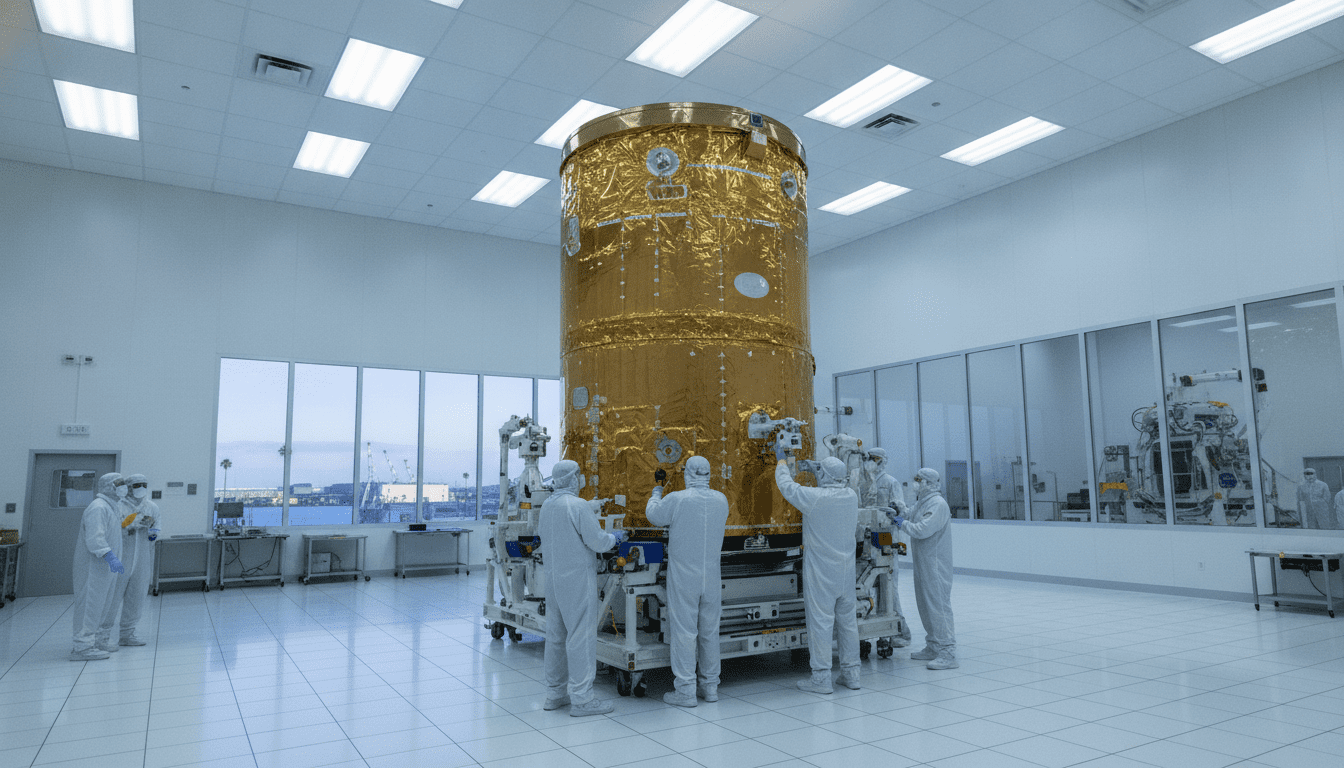
Rocket Lab satellite readied in Long Beach clean room for a high-value mission
A compact, gold-clad Rocket Lab satellite is undergoing final assembly in a Long Beach clean room as the US launch company prepares the craft for a demanding customer. The satellite, roughly the size of a refrigerator and valued in the multimillion-dollar range, is being protected behind plastic curtains and strict contamination controls. Engineers say the build emphasizes reliability and precision to meet tight mission and environmental specifications.
Satellite Prepared in Long Beach Clean Room
The satellite sits behind suspended plastic curtains inside a controlled environment where even microscopic dust is excluded. Technicians work in full clean-room gear to prevent particulate contamination that could impair sensitive optics, propulsion or electronics once the vehicle reaches orbit.
The assembly area is configured to minimize handling and maintain a sterile air flow, with workstations aligned around the unit to support sequential build and inspection procedures. Those measures reflect routine industry practice for high-stakes spacecraft and underscore the premium placed on long-term operational reliability.
Design and Materials Reflect Commercial Precision
Externally the satellite appears wrapped in a golden thermal blanket, a sign of multilayer insulation used to regulate internal temperature in orbit. Its compact footprint belies complex internal systems, including power, communications and attitude control subsystems tailored for the mission profile.
Engineers have to balance mass, volume and power budgets within tight constraints, which often drives iterative trade-offs in component selection and structural design. The result is a heavily integrated platform that leverages modern miniaturization while protecting key elements from the harsh space environment.
Contamination Control and Testing Regimen
Maintaining an ultra-clean environment is only one element of a broader verification program that typically includes vibration, thermal vacuum and electromagnetic compatibility testing. Each test subjects the satellite to simulated launch stresses and orbital extremes to uncover vulnerabilities before flight.
Quality-control teams also inspect harnesses, connectors and seals for assembly integrity, logging any anomalies for rework. Final acceptance often depends on meeting a rigorous checklist tied to mission assurance, ensuring the customer receives a spacecraft that meets contractual performance margins.
Customer Requirements Drive Custom Integration
Rocket Lab is building this unit to satisfy a demanding customer, which has influenced configuration choices and test depth. Those requirements commonly dictate redundancy levels, deorbit capability, and data throughput, all of which affect schedule and cost.
Custom interface work may also be required to match the satellite to a specific launch vehicle or payload dispenser, leading to additional verification steps. Close coordination between manufacturer and customer is necessary to resolve technical questions without jeopardizing the flight manifest.
Launch Campaign and Operational Handover
After environmental testing and final functional checks, the satellite will enter a pre-launch campaign that typically includes fueling, encapsulation and transport to the launch site. Engineers will then conduct integrated checks at the launch complex before the spacecraft is mated to its rocket or deployment mechanism.
Operational handover to the mission integrator or operator follows successful launch and on-orbit commissioning, a phase during which telemetry, power and pointing control are verified. Only after those milestones is the mission considered ready to begin nominal operations.
Implications for Rocket Lab and the Small-Satellite Market
This build highlights Rocket Lab’s growing role beyond launch services into end-to-end spacecraft integration and supply for high-value missions. Expanding into manufacturing allows launch providers to offer bundled solutions that can reduce complexity for customers and accelerate mission timelines.
For the broader small-satellite market, increased vertical integration by launch companies may lower barriers for operators needing rapid deployments, while also concentrating technical responsibility with a single provider. The balance between specialization and turnkey services will remain a strategic choice for companies and their customers.
The satellite’s final preparations in Long Beach reflect an industry where meticulous assembly, exhaustive testing and close customer collaboration combine to turn a gold-clad unit in a clean room into a functioning asset in orbit.
