
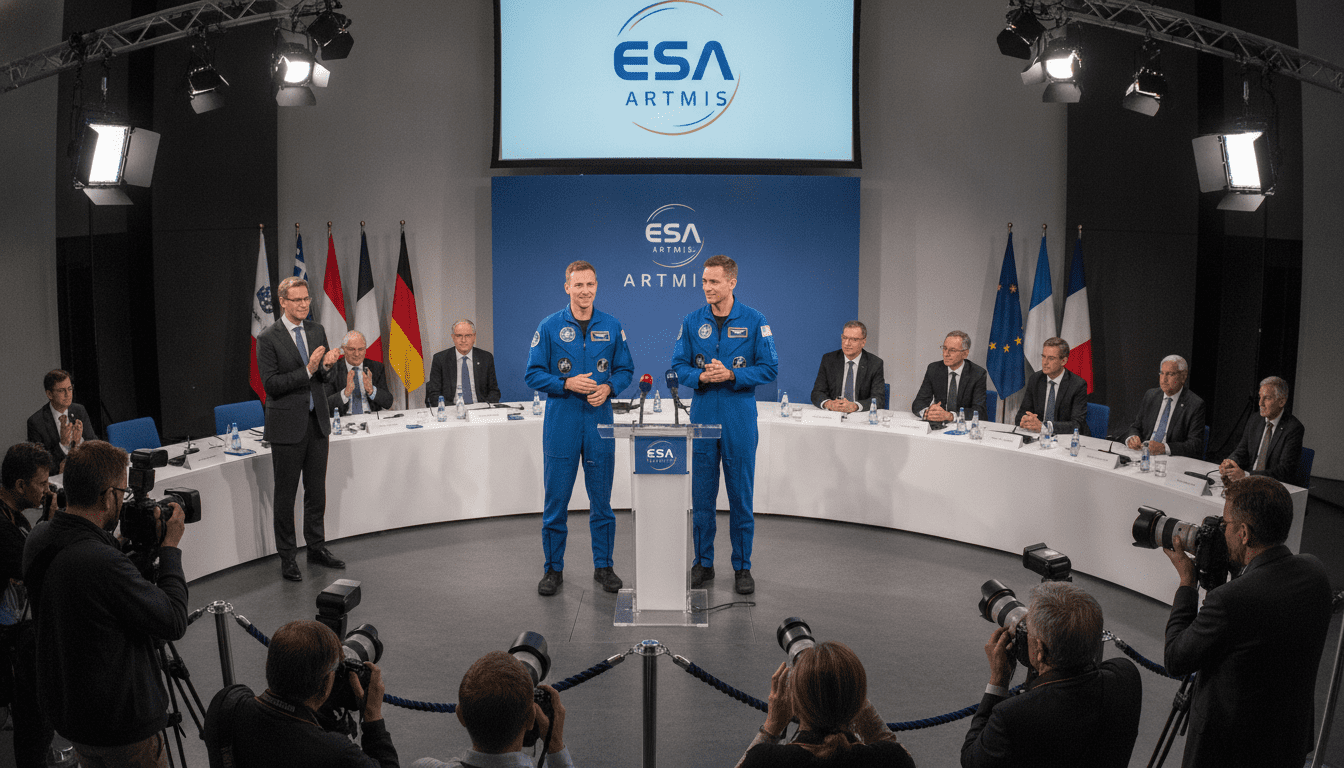
ESA astronauts moon mission: Aschbacher names German, French and Italian as first European flyers
Josef Aschbacher names nationalities for the first European moon mission: German, French and Italian astronauts—Germany’s crew to fly first, ESA confirms.
The head of the European Space Agency (ESA) announced at the end of 2025 that the first Europeans to fly on a moon mission will be ESA astronauts of German, French and Italian nationality, setting a clear national order for future lunar crews. The decision marks a pivotal moment for European participation in human lunar exploration and places Germany at the front of the line for the first opportunity. ESA astronauts moon mission appears poised to shift the agency’s human-spaceflight priorities toward a coordinated European presence on lunar missions. The announcement has already ignited discussions in member states about training, selection and the scientific role European crew members will play.
Aschbacher’s statement and the national sequence
Josef Aschbacher publicly declared the nationality sequence at the end of 2025, saying the first Europeans on a moon mission would come from Germany, France and Italy. His remarks clarified a previously opaque timeline for which nationalities ESA intends to nominate when crew opportunities on lunar missions arise. By setting nationalities rather than naming individuals, the agency signaled both political considerations and an intent to align member-state commitments with crew assignments. The move is likely intended to provide predictability for national space agencies and governments preparing astronauts, training programs and funding.
German candidates and their readiness
Germany’s two most prominent ESA astronauts, Alexander Gerst and Matthias Maurer, have repeatedly expressed strong interest in lunar flight opportunities and were identified by name in domestic coverage as natural candidates. Both men have extensive experience on the International Space Station and have been prominent public faces for European human spaceflight programs. Their previous long-duration missions and roles in science and outreach make them credible contenders should Germany be asked to nominate crew. The emphasis on Germany going first reflects both political weight within ESA and the readiness of German astronauts and infrastructure to support a lunar assignment.
Implications for ESA’s cooperation with NASA
The announcement arrives within the context of Europe’s ongoing partnership with NASA on crewed lunar exploration under the Artemis framework, where ESA contributes hardware, services and specialist training. Naming the nationalities for the first European participants signals a new phase in that partnership: European crew members would bring national scientific priorities and technical expertise directly to lunar missions. For NASA and international partners, predictable European nominations can simplify mission integration and scheduling, while also raising expectations for Europe to supply mission-critical capabilities and mission support. The exact mission roles, whether transit crew, surface operations partners or scientific leads, will depend on further agreements between ESA, national agencies and international partners.
Selection, training and programmatic steps ahead
Following the national announcement, practical steps will include formal nominations by national agencies, mission assignment by ESA, and integration with international mission crews and timelines. Astronaut selection for a lunar mission will likely hinge on mission-specific skills, such as EVA (spacewalk) experience, systems operations and scientific expertise, as well as health and long-duration flight readiness. Training regimens will need to expand beyond low-Earth orbit profiles to include lunar-descent, surface operations and contingency procedures, requiring new simulations and partnerships with established training centers. Funding and hardware timelines will also shape how quickly nominees can be certified and integrated into a flight manifest.
Political and scientific stakes for member states
Assigning nationalities for the first European lunar flyers has clear political resonance: it delivers a tangible return on member-state investments in ESA and anchors national prestige in a high-profile international program. For Germany, the chance to send its astronauts first is likely to bolster domestic support for civil space budgets and industrial contracts. For France and Italy, the designation signals forthcoming opportunities to highlight national science experiments and technology contributions on lunar missions. Scientific communities across Europe are already calculating the potential benefits, from geology and astrophysics to life sciences, that a European crew could pursue during transit and surface operations.
Uncertainties and the timeline to launch
Despite the announcement, significant uncertainties remain about exact mission dates, crew compositions and mission roles for European astronauts on lunar flights. ESA has yet to publish a detailed timetable tied to specific Artemis missions, and final crew assignments will depend on international scheduling, spacecraft availability and national approvals. Technical integration, medical certification and training slots will all influence when those first European flyers can actually ride a lunar mission. For now, the announcement establishes national order, but not firm launch dates or operational responsibilities.
The decision to name German, French and Italian nationals as the first Europeans slated for lunar missions sets a new course for ESA’s human spaceflight efforts and elevates expectations across capitals in Europe. As national agencies move from political confirmation to operational planning, attention will focus on who is formally nominated, how training is accelerated and what scientific objectives those astronauts will pursue when they reach lunar orbit or the surface.
