
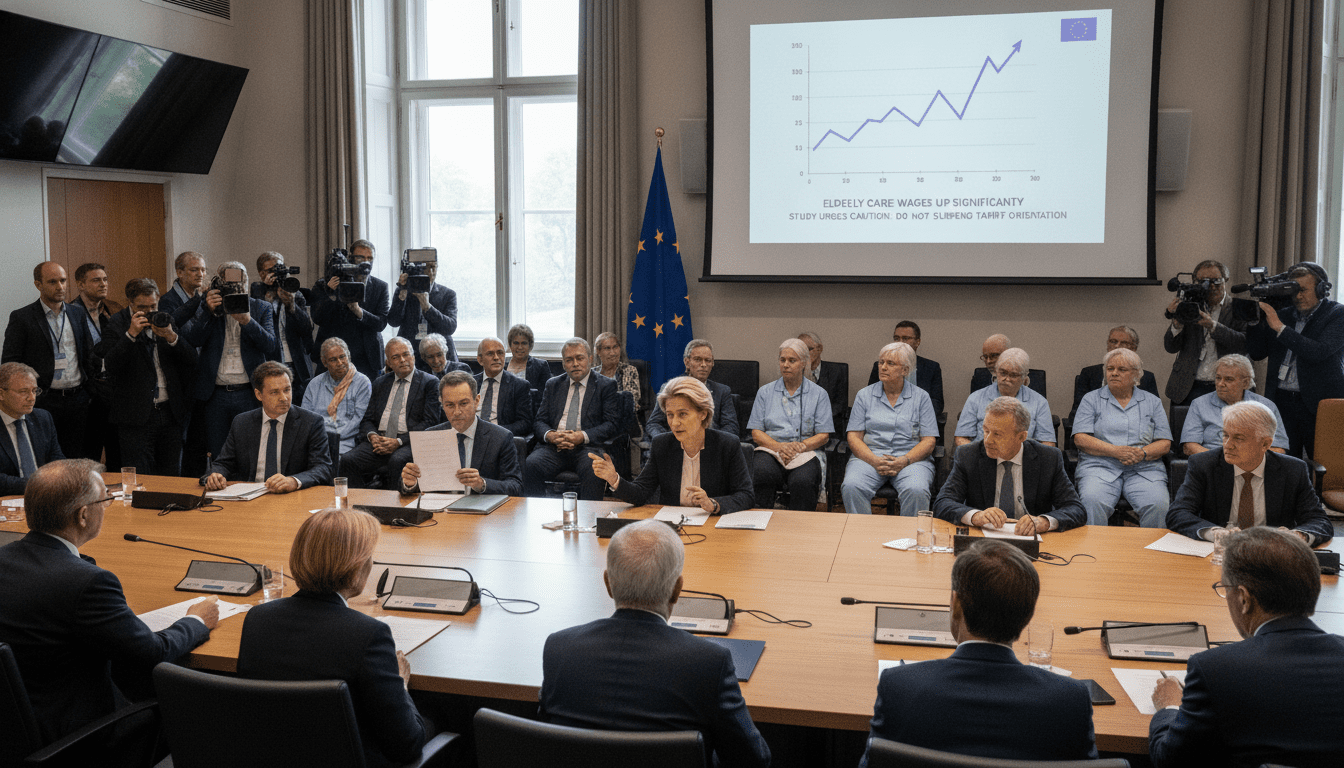
Study: Tariff orientation lifted long-term care wages but ministry proposes temporary suspension
New evaluation shows tariff orientation raised long-term care wages sharply; ministry plans a 2027–2030 moratorium in PNOG amid rising costs and policy debate.
Germany’s recently reviewed evaluation finds that the 2022 tariff orientation policy substantially increased pay in long-term elder care, but the federal health ministry is preparing a temporary suspension beginning in 2027 to blunt rising costs. The report, commissioned by the ministry and carried out by institutes in Gelsenkirchen and Bremen, links much of the wage growth to tariff orientation in long-term care and warns that a market-only approach may not guarantee sustained, equitable pay.
Study attributes faster wage growth to tariff orientation
The evaluation examined pay developments after the Pflegelohngesetz and the September 2022 health-sector reform that tied provider approval and funding to conformity with collective agreements or comparable church rules. Researchers report nominal hourly increases of roughly €3–4 since 2022 for long-term care positions, equivalent to 17–22 percent depending on role, compared with under 16 percent in the broader labor market. Consumer prices rose about 8 percent over the same period, meaning real wages for many care workers improved noticeably.
Concrete wage levels and sectoral shifts
Measured without overtime and allowances, the study finds ambulatory specialist nurses averaged about €23.60 per hour and their residential counterparts about €24.20; nursing assistants reached up to €18.80 per hour. The analysis shows that the historical pay gap between long-term care staff and hospital nurses has roughly halved since the tariff orientation was implemented, reflecting a significant relative catch-up. Authors caution, however, that these figures are driven primarily by the application of existing tariff deals rather than by a steadily rising statutory minimum.
Ministry’s PNOG plan: a four‑year moratorium from 2027
The health ministry, led by Minister Nina Warken, is using the evaluation to support legislative changes in the Pflegeneuordnungsgesetz (PNOG) that would suspend the requirement to demonstrate tariff-level pay. Under the proposal, providers would no longer have to prove tariff compliance starting in 2027, with a moratorium running from January 1, 2027, through December 31, 2030, after which tariff orientation would resume. The ministry argues the pause will reduce administrative burdens and test whether wages remain adequate without regulatory proof.
Rising costs passed to insurers, residents and municipalities
The evaluation links the tariff-orientation rule to pronounced cost increases for care services: care-home rates rose by about 24 percent between 2022 and 2024, and ambulatory care prices climbed nearly as much. The total per‑bed fee increased by roughly €790 per month to about €4,290, according to the study, with residents often bearing two‑thirds of first-year costs. In 2024, data cited by the report show first-year resident contributions averaged about €2,870, while municipal social assistance payments for people unable to cover fees reached approximately €5.3 billion.
Experts warn revocation risks reversing gains
Although the ministry presents the wage improvements as policy success, the study’s authors are skeptical of a full revocation of tariff orientation. The evaluation models a “revocation scenario” but rejects it as politically fraught and economically uncertain, noting market forces alone may not prevent renewed wage disparities between providers. Researchers emphasize the danger of a renewed divergence in pay that could undercut the long-term professionalization and attractiveness of care work.
Study proposes targeted adjustment rather than repeal
Rather than endorsing the ministry’s moratorium outright, the researchers propose an alternative “adjustment” to the mechanism that determines regionally customary pay levels (regional übliche Entgelte, RÜE). One practical suggestion is to compute RÜE using the full set of tariff rates but exclude the highest outliers before forming the reference value, thereby capping extremes without abolishing the tariff benchmark. The authors argue such a recalibration could temper upward pressure on costs while preserving a collective‑agreement anchor for wages.
The evaluation thus frames the policy choice as a trade‑off between containing rising provider costs and maintaining an institutional guarantee that helped raise care wages after 2022. The ministry’s proposed PNOG moratorium would test whether wages remain adequate without mandatory tariff proof, while researchers urge safeguards to prevent a renewed erosion of pay differentials and the gains made for long‑term care professionals.
