
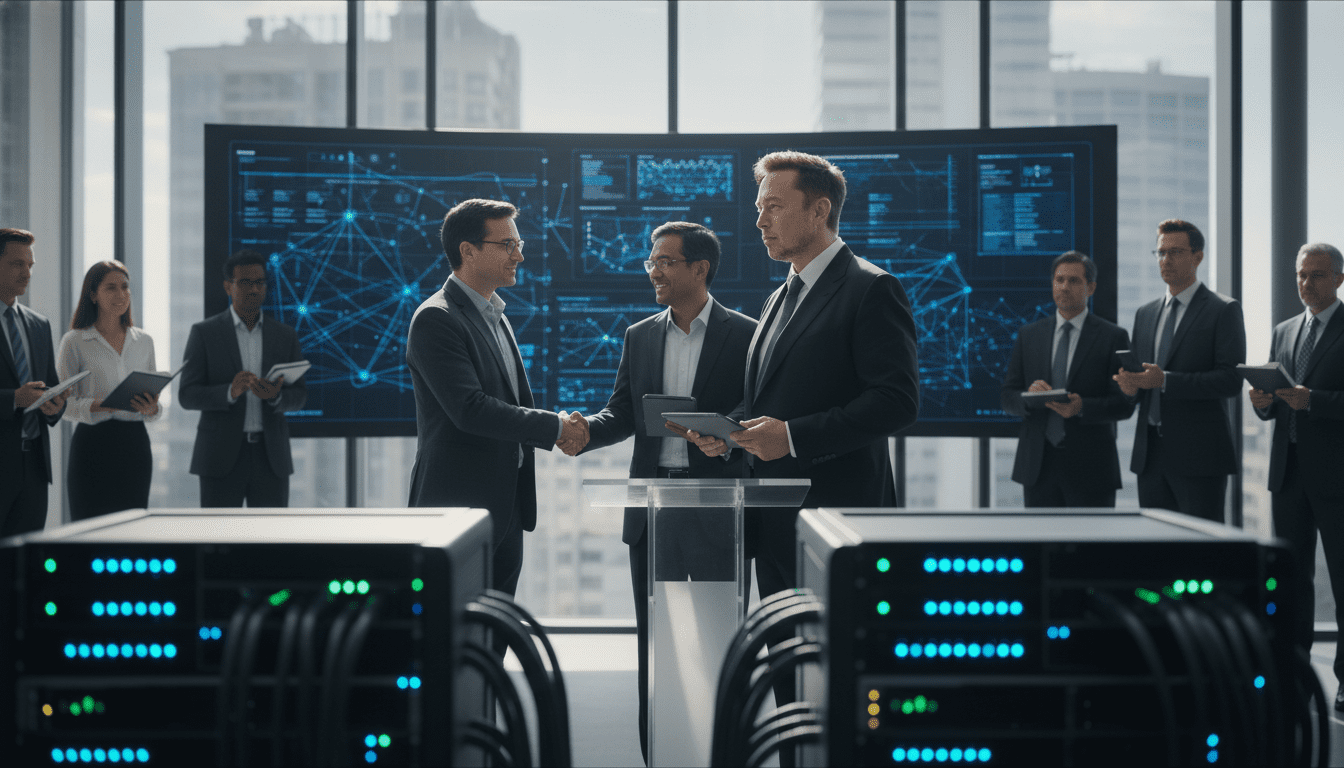
Elon Musk Rents Compute to Anthropic and Google, Intensifying AI Competition with OpenAI
Elon Musk rents compute to Anthropic and Google, supplying crucial processing power that bolsters rivals’ AI development and reshapes the competitive landscape with OpenAI as infrastructure costs climb.
Elon Musk rents compute to Anthropic and Google, a move that is giving both companies access to large-scale processing capacity at a time when AI model training is increasingly resource‑intensive. The arrangement is notable because it positions Musk, a former OpenAI co‑founder, as a provider of infrastructure that strengthens competitors to the company with which he has long-running tensions. Observers say the development highlights how essential third‑party compute capacity has become to the AI race.
Musk’s Compute Rentals to Anthropic and Google
Elon Musk’s decision to lease compute capacity has delivered immediate, practical benefits to Anthropic and Google by expanding their ability to run large‑scale model training and experimentation. The compute capacity being offered reduces a key bottleneck for organizations seeking to iterate on foundation models more quickly. For companies without unlimited internal data‑center capacity, access to external compute can materially shorten development cycles.
Support for Rivals in the OpenAI Feud
The compute provision is striking because Musk was an early co‑founder of OpenAI and has been publicly at odds with the organization since leaving. By supplying Anthropic and Google with processing power, Musk is indirectly altering competitive dynamics in the AI field. Analysts note the move effectively strengthens OpenAI’s rivals at a time when the three firms are jockeying for talent, customers, and model leadership.
AI Infrastructure Costs and Demand for Compute
Training state‑of‑the‑art models requires sustained access to thousands of accelerators and vast energy and network capacity, making AI infrastructure a costly, capital‑intensive business. Companies that can secure large batches of compute time gain an advantage in experimenting with model architectures and scaling tests. The scarcity and expense of high‑performance compute have prompted an active market for rented capacity, specialized cloud offerings, and bespoke hardware arrangements.
Google’s $190 Billion Capital Plan for Data Centers
Google has announced capital investment plans of up to $190 billion for the year, with a substantial portion earmarked for data‑center expansion and related infrastructure. That level of planned spending underscores how critical physical plant and compute capacity are to leading cloud and AI platforms. For Google, investing in data centers is both a defensive and offensive strategy: it supports its cloud customers while underpinning internal model training and product deployments.
Strategic Effects on AI Product Development
Access to rented compute can accelerate product timelines by enabling more frequent training runs, larger hyperparameter sweeps, and quicker iteration on safety mitigations. For Anthropic and Google, the immediate gains include faster prototyping and greater capacity for multi‑model experimentation. Over time, however, reliance on an external provider for significant compute volume may raise strategic questions about supply stability and bargaining leverage.
Market Responses and Industry Outlook
Industry participants are watching how compute availability will influence partnerships, pricing, and the shape of the market for AI services. If more high‑capacity providers choose to lease excess compute, the barrier to entry for smaller AI labs could lower, broadening competition in model research and deployment. Conversely, concentration of compute control with a few suppliers could create new chokepoints that reshape bargaining dynamics across the sector.
The shift also highlights a broader tension in the AI economy: whether dominant firms will vertically integrate infrastructure or rely increasingly on a marketplace of compute providers. That balance will determine how quickly models proliferate, how innovation is distributed, and which companies control the levers of scale.
Longer term, the interplay between capital investment in physical data centers and flexible, rented compute capacity will be a central determinant of which AI organizations can sustain high‑velocity development. The decision by Elon Musk to rent compute capacity to competitors illustrates how infrastructure choices can have outsized strategic effects across the technology ecosystem.
