
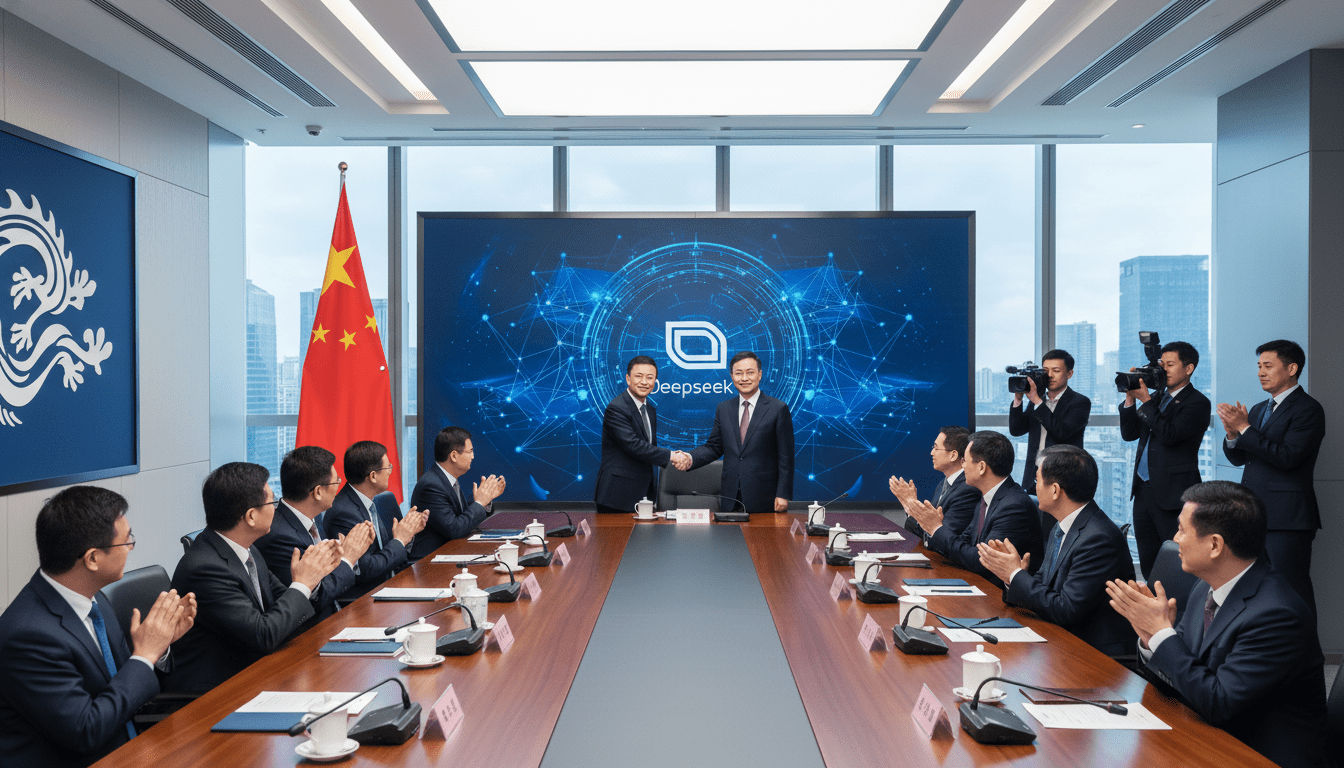
Deepseek raises nearly €6.4bn in one of China’s largest AI funding rounds
Deepseek funding round: Chinese AI leader secures roughly 50 billion RMB in strategic investment, valuing the start-up at about 350–400 billion RMB.
Deepseek funding has attracted roughly 50 billion renminbi in a high-profile capital raise that positions the Hangzhou-based start-up as a potential national champion in artificial intelligence. Founder Liang Wenfeng is reported to supply a substantial portion of the capital, while major Chinese technology and industrial groups join as strategic investors. The fresh financing aims to shore up research capacity, stabilize talent retention and deepen ties with domestic infrastructure providers.
Size and structure of the financing
Reports from Reuters and Bloomberg say the round totals about 50 billion RMB, of which roughly 20 billion RMB comes from Liang Wenfeng’s own High‑Flyer fund and about 30 billion RMB from outside investors. The deal gives Deepseek a valuation in the range of 350–400 billion RMB, equivalent to approximately 45–50 billion euros.
Industry observers describe the transaction as one of the biggest private financings in recent Chinese corporate history. The scale is large by domestic standards but remains smaller than headline valuations attributed to some U.S. AI rivals.
Who is investing and why
Tencent is reported to be contributing about 10 billion RMB and the battery giant CATL about 5 billion RMB, with other potential participants including JD.com and China’s national AI fund. No party had publicly confirmed the investment at the time of reporting, but multiple agency accounts cite unnamed sources close to the negotiations.
Investors appear motivated by both commercial and strategic reasons. Tencent can leverage its distribution ecosystem to deploy Deepseek’s models, while CATL’s involvement signals interest in the energy and infrastructure requirements of large-scale AI operations.
Founder control and equity stakes
Liang’s self-investment preserves a dominant ownership position, with reports indicating he will retain roughly 70 percent control after the round. The founder’s continued majority stake should allow him to direct long‑term product and strategy choices while drawing on new partners for scale and deployment.
That ownership arrangement also explains why Deepseek has previously been unwilling to grant widely tradable, valued equity to employees, a point that intersected with talent retention challenges.
Talent pressures and retention strategy
Deepseek has faced an exodus of engineers and researchers in recent months, with many reportedly leaving for rivals such as Xiaomi and ByteDance where stock awards had clearer valuations. The new funding round is intended to address that gap by creating a valuated equity structure and providing fresh resources for compensation and incentives.
Company insiders and market analysts say the combination of cash, clearer equity value, and strategic partnerships will make Deepseek more competitive in recruiting and holding top AI talent inside China.
Technology position and market perception
Deepseek emerged from Hangzhou with models that briefly sparked global market attention and prompted talk of a Chinese “Sputnik moment” in AI. Since that peak, the company has struggled to maintain leadership as successor models from both domestic and foreign competitors attracted more attention.
Nevertheless, Deepseek remains the best-known Chinese AI start-up and retains a strong brand effect on how investors and markets view China’s capacity for advanced AI research.
Geopolitical and industrial implications
The reported mix of investors — prominent domestic tech firms, industrial players and a state-linked AI fund — underscores Beijing’s preference for homegrown AI capabilities. Analysts at Hutong Research and other consultancies say the national fund’s involvement would effectively anchor Deepseek as a strategic domestic asset.
That alignment reduces the likelihood of significant foreign participation in this round, reinforcing a broader trend toward technological self-reliance and closer state-industry coordination in strategic sectors.
Deepseek’s funding round will test whether concentrated domestic capital can match the technological momentum fostered by more internationally financed rivals, and whether the start-up can translate headline valuations into sustainable product leadership and commercial deployments.
