
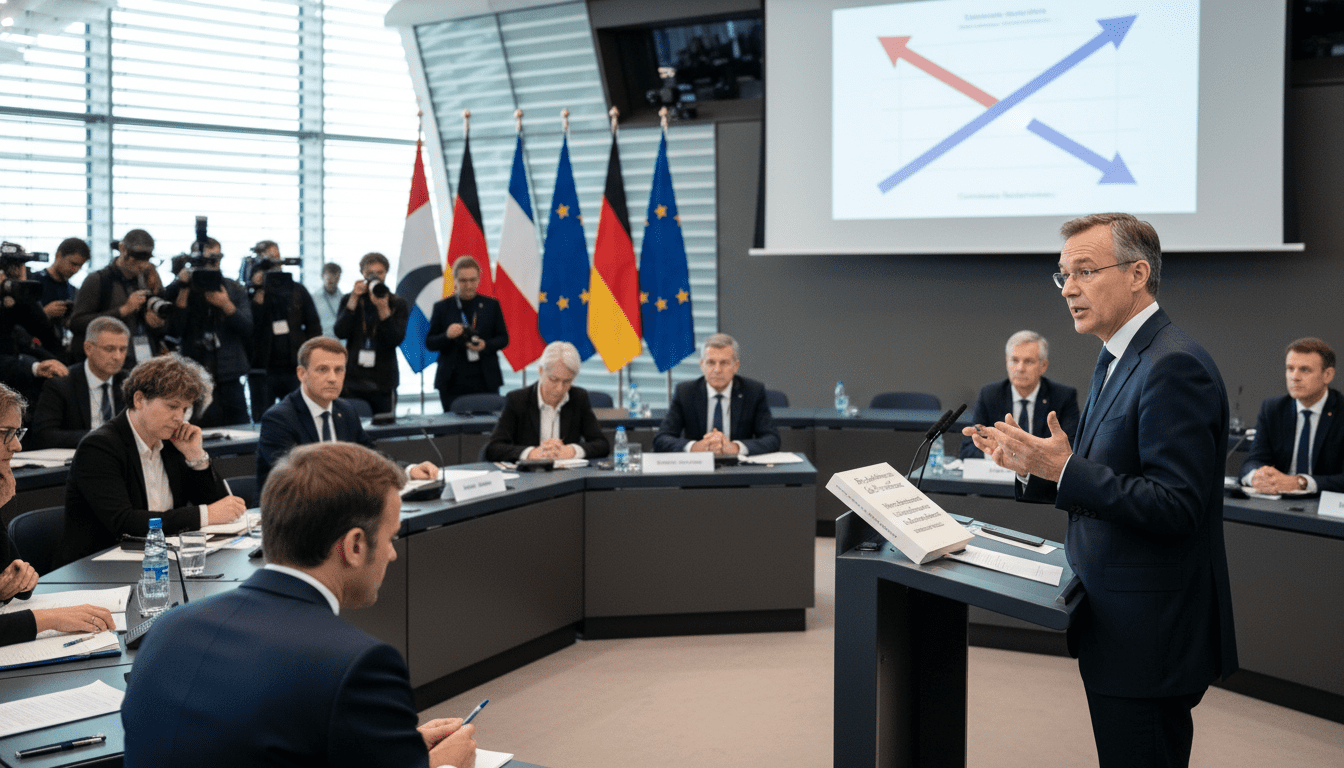
Germany without America: Holger Stark’s warning for Berlin and a call for strategic autonomy
Holger Stark’s Das erwachsene Land warns of ‘Germany without America’ and urges Berlin to adopt strategic autonomy and prepare Europe for a post‑transatlantic era.
Holger Stark, deputy editor of Die Zeit, argues in his new book that a long‑simmering transatlantic crisis has escalated to a point where Germany must plan for a future he calls “Germany without America.” The book draws on interviews in Berlin, Brussels and Washington and links recent U.S. policy shifts to deep social and political changes inside America. Stark’s central claim is that the “America First” era has transformed Washington from ally to unpredictable rival, compelling Berlin to rethink its strategic dependence. The argument frames a potential German pivot as both a necessity and an opportunity for European influence.
Reporting from Berlin, Brussels and Washington
Stark structures his reportage around extensive conversations with politicians, officials and analysts across three capitals, reconstructing policy choices and private debates. He uses these interviews to trace how transatlantic trust frayed over the past quarter century and to document specific moments of rupture during recent U.S. administrations. The narrative foregrounds firsthand accounts that illustrate how alliance expectations dissolved into transactional diplomacy. Those sources underpin Stark’s claim that a durable change in U.S. foreign policy orientation has taken hold.
Two American crises reshaped policy
The book attributes the transformation in U.S. policy to two broad crises: the economic dislocation of white working‑class communities and the political fallout from prolonged wars in Afghanistan and Iraq. Stark contends that these developments radicalized parts of the electorate and empowered leaders who view global engagement skeptically. That shift produced a political culture more comfortable with isolationist rhetoric and hard bargaining abroad. For Stark, these domestic dynamics explain why the United States increasingly treats allies as competitors rather than partners.
From alliances to transactional deals
Stark observes a systematic move from traditional alliance frameworks toward day‑to‑day dealmaking, where commitments are contingent and reversible. He highlights the rhetoric of “America First” and the influence of figures who prioritize short‑term national advantage over multilateral cooperation. Economic competition, not shared values, now often frames transatlantic interactions, according to the book. This transactional turn, Stark warns, makes long‑term security arrangements less reliable for European governments.
What “Germany without America” would mean for Berlin
For Germany, Stark argues, the practical implications are stark: Berlin would need to assume greater responsibility for its defense, diplomacy and industrial resilience. He frames this shift as a possible “second fall of the wall” moment — a painful break that could catalyze political maturity and strategic independence. The author urges German leaders to prepare contingency plans while preserving useful ties to Washington. Stark cautions that decoupling entirely would be unwise, but he insists on a stronger, self‑reliant German posture within a more plural global order.
Europe’s window for strategic autonomy
Stark presents a hopeful scenario in which Europe emerges as an independent power pole alongside the United States, China and Russia, but he admits the roadmap is imprecise. He outlines areas where European coordination could grow — defense cooperation, industrial policy and diplomatic alignment — while noting the persistent political and structural hurdles. The book calls on European capitals to translate strategic intent into concrete capabilities, from integrated procurement to shared crisis planning. Stark stresses that time is limited: if Europe hesitates, gaps in security and influence will deepen.
Publication details and early reactions
Das erwachsene Land, published in 2026 by Propyläen and Ullstein Buchverlage, runs to 333 pages and is presented as a journalistic reconstruction rather than an academic study. The volume’s epilog, titled “Goodbye, America,” crystallizes the central thesis and has already sparked debate in policy circles. Critics and supporters alike note the book’s accessible reporting and the urgency of its central question for German foreign policy. Policymakers will likely weigh Stark’s diagnosis as Berlin prepares for a strategic environment that may be less reliant on U.S. guarantees.
Stark’s book forces a debate about how Germany and its European partners should balance continued transatlantic cooperation with the need for greater self‑help, and it will in turn shape conversations in capitals across the continent.
