
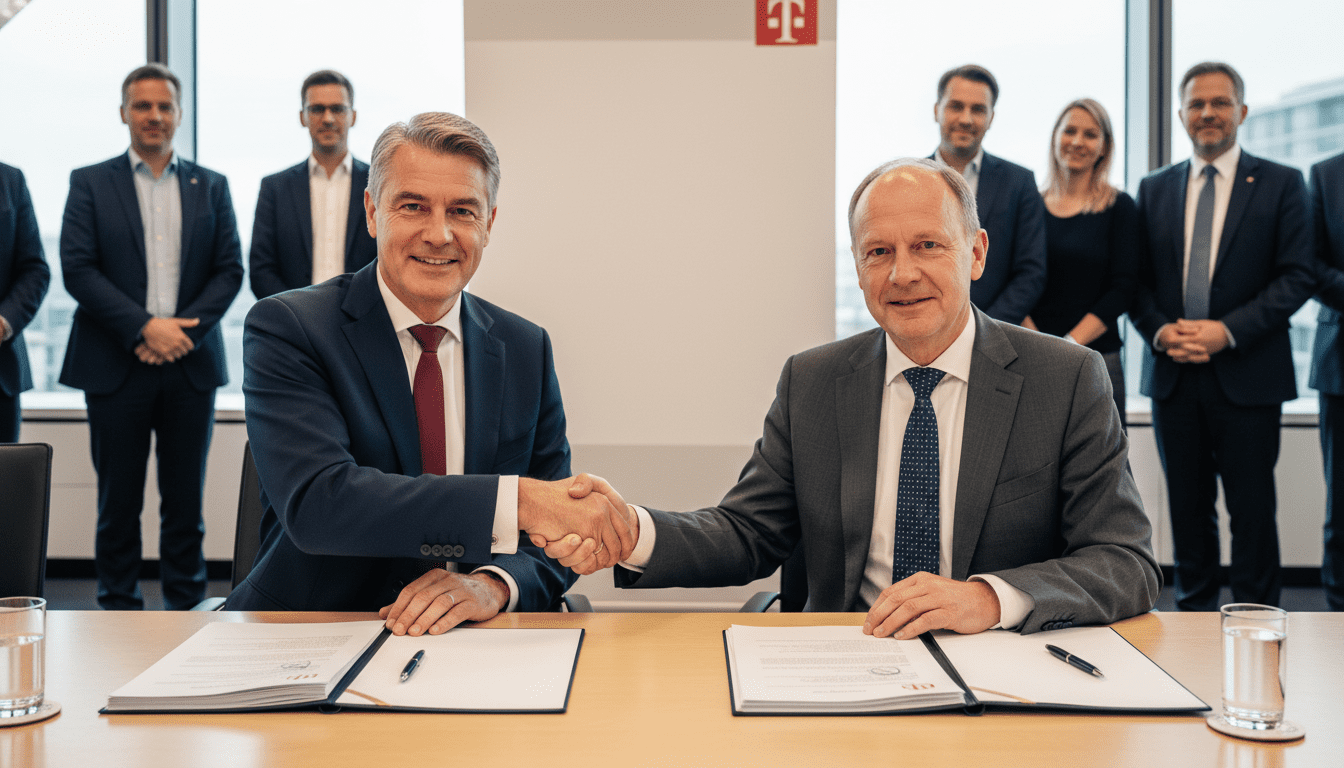
Telekom tariff agreement reached with Verdi after 36-hour talks, raising pay and extending job protection
Telekom tariff agreement ends a long dispute for about 60,000 employees, raising permanent allowance and extending job protection through December 31, 2028.
The Telekom tariff agreement reached on the fourth day of negotiations ended a nationwide dispute affecting roughly 60,000 Deutsche Telekom employees after a 36-hour bargaining marathon. The deal raises the company’s permanent additional monthly allowance, sets further raises for 2027 and 2028, and guarantees protection against business-related dismissals for the full term of the contract. The agreement also introduces a first-time membership bonus for Verdi members and removes the immediate threat of layoffs while the tariff runs until December 31, 2028.
Key financial terms in the tariff deal
The negotiated package increases the so-called additional monthly compensation for Telekom group employees from €190 to €340 beginning in August 2026. That component is scheduled to rise again to €480 in July 2027, delivering a significant, staged boost to take-home pay. In addition to the allowance increases, the collective agreement sets a further increase of 2.4 percent to table wages effective June 2028.
The staggered structure blends immediate relief with longer-term adjustments, creating a layered pay trajectory that Telekom says balances affordability and predictability. Overall, the measures aim to provide workers with sustained income improvements across the multi-year contract period.
Job security guaranteed for the contract duration
A central component of the Telekom tariff agreement is the extension of dismissal protection: the company agreed to exclude business-related layoffs for the entire lifespan of the collective agreement. The tariff contract runs for 33 months and is explicitly set to expire on December 31, 2028. The no-dismissal clause is designed to give employees and works councils a stable planning horizon during a period of business transformation.
Trade union representatives framed the job security provision as a major victory after months of mobilization and warning strikes, while the company characterized the clause as part of a balanced approach to workforce stability and operational continuity.
Member bonuses and eligibility specifics
For the first time under a Telekom collective agreement, Verdi secured a membership bonus for eligible employees. Workers who were Verdi members as of the cut-off date, May 28, 2026, will receive a one-time payment of €440 in 2026. Employees who remain union members at the end of 2028 will be entitled to an additional €220 bonus, effectively rewarding continued union affiliation across the contract term.
Verdi had initially demanded larger immediate increases and a higher member bonus; the union sought a 6.6 percent wage rise within a 12-month contract and a €660 membership payment in 2026. The compromise reflects a trade-off between shorter-term demands and multi-year guarantees negotiated at the table.
Union and management responses to the agreement
Verdi’s lead negotiator described the outcome as achieving core aims of the bargaining round, praising strong employee participation in strikes and public actions. He summed up the outcome as delivering “more money, more protection, more recognition, more solidarity,” framing the accord as a collective success for members who took part in industrial measures.
Deutsche Telekom’s personnel executive called the pact “a balanced settlement” that provides stability while delivering a meaningful pay increase for staff. Management emphasized the importance of predictability for business planning and the need to sustain investment while meeting employee expectations.
Negotiation timeline and industrial context
The settlement was reached in the fourth round of talks after an intensive 36-hour negotiation marathon that pushed through overnight and into the following day. The talks followed weeks of targeted warnings, localized walkouts, and public demonstrations organized to press for higher wages and job protections. The bargaining climate reflected tensions common to large German collective negotiations this year, with unions pressing for real-term gains amid inflationary pressures.
Both parties credited active engagement — from union members and company negotiators — for bringing the talks to a conclusion. The staged pay increases and the extended contract period suggest a negotiated emphasis on long-term stability rather than a single-year spike in remuneration.
Implications for Telekom’s workforce and labor relations
The agreement secures immediate and phased salary improvements while insulating employees from company-initiated layoffs through the end of 2028, which will affect workforce planning and internal reorganization efforts. For employees, the combination of allowance increases and membership bonuses boosts near-term income and preserves job security across multiple business cycles.
For Deutsche Telekom, the agreement re-establishes operational certainty and removes the immediate risk of recurring strike escalation, though it commits the firm to higher labor costs over 33 months. Labor relations observers say the deal may set a reference point for collective bargaining at other large employers, particularly where unions combine wage demands with calls for stronger social protections.
The tariff agreement now requires implementation steps at company level and administrative follow-through to ensure timely payments and that the no-dismissal provisions are enforced as agreed through December 31, 2028.
