
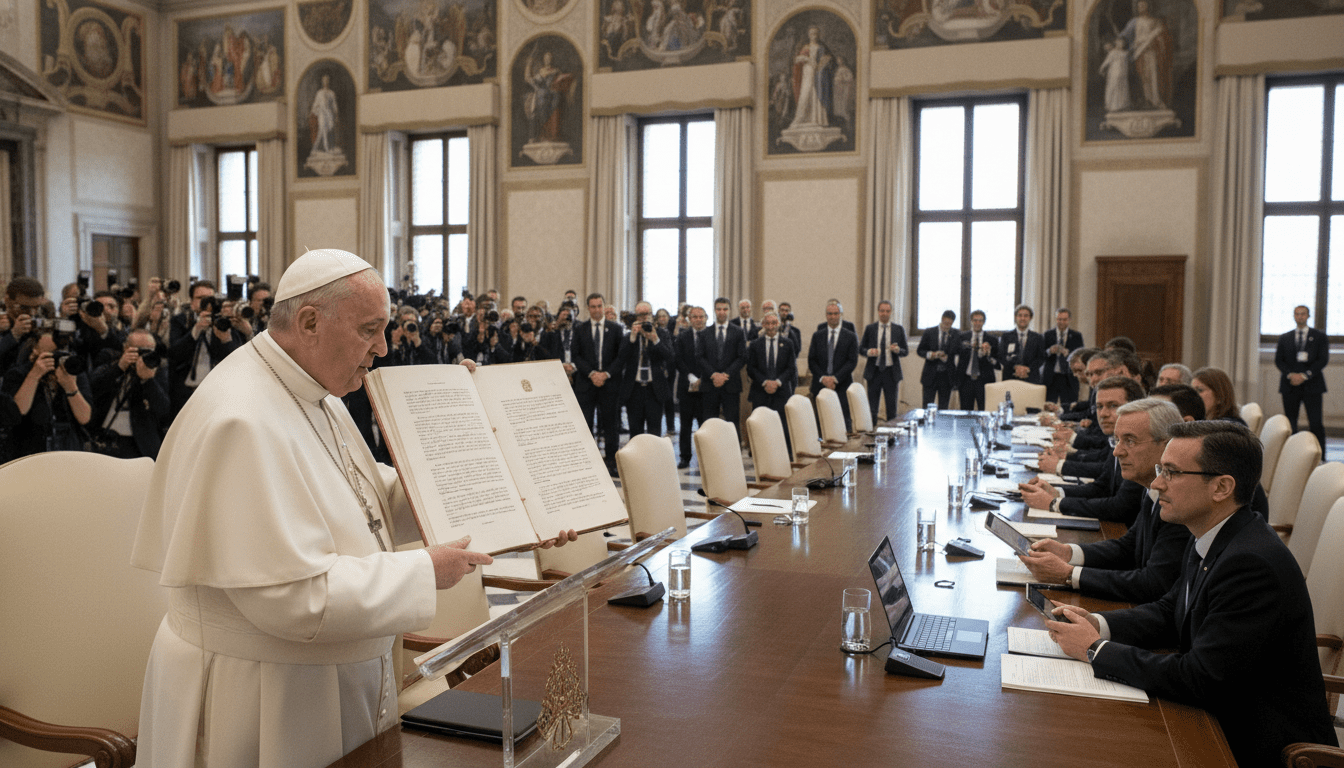
Pope Leo XIV Encylcical on AI Sets Ethical Agenda After Decade of Vatican–Silicon Valley Dialogue
Pope Leo XIV’s encyclical on AI sets moral principles and policy proposals for artificial intelligence, shaped by a decade-long Vatican–Silicon Valley dialogue.
Pope Leo XIV Presents Encyclical on Artificial Intelligence
Pope Leo XIV surprised international audiences on Pentecost Monday by publishing a major encyclical devoted to artificial intelligence. The document, presented in St. Peter’s Square, frames AI not only as a technological challenge but as a moral and social question requiring coordinated global responses. The encyclical explicitly links the Catholic Church’s social teaching to the governance and development of AI, using the phrase “Pope Leo XIV encyclical on AI” to anchor its central message.
Decade-long Vatican–Silicon Valley Exchange Informed Text
Vatican officials said the writing of the encyclical draws on more than ten years of discreet exchange with technologists and ethicists in Silicon Valley. That prolonged dialogue, officials say, helped Vatican theologians and curial offices gain a technical literacy sufficient to address algorithmic risk and opportunity. The result is a text that reflects both theological concerns and an understanding of contemporary machine-learning architectures and governance debates.
Encyclical Focuses on Human Dignity and Moral Formation
A central theme of the encyclical is the protection of human dignity in the design and deployment of AI systems. The document calls for AI development that preserves human agency, promotes flourishing, and avoids treating persons as mere data points. It also emphasizes the need for moral formation, urging institutions to educate engineers, policymakers, and citizens about ethical decision-making in technology.
Concrete Recommendations for Regulation and Design
Beyond principles, the encyclical offers concrete policy recommendations aimed at tech companies and governments. It advocates for “ethics by design,” insisting that moral safeguards be built into systems from inception rather than added later. Transparency, meaningful human oversight, informed consent in data use, and accountability mechanisms for autonomous systems are listed as priority measures for implementation.
Appeal for Global Cooperation and Institutional Oversight
Pope Leo XIV’s document calls for international cooperation to align AI standards with fundamental human rights and common goods. The text urges states and multilateral organizations to develop binding norms that prevent the weaponization of AI and protect vulnerable populations. It also proposes that supranational bodies consider certification or audit regimes to verify compliance with ethical standards.
Responses from Technology Leaders and Religious Communities
Initial reactions from Silicon Valley and faith communities were mixed but engaged, with several technology executives welcoming dialogue and others cautioning against prescriptive rules that could stifle innovation. Religious scholars praised the encyclical’s emphasis on dignity but some urged clearer mechanisms for operationalizing its recommendations. Human-rights advocates said the moral orientation was welcome but warned that words must quickly translate into enforceable policy.
Practical Steps for Churches, Universities, and Industry
The encyclical sets out steps for religious institutions, educational bodies, and companies to operationalize its vision. It encourages Catholic universities to expand interdisciplinary programs pairing theology and computer science, and it asks dioceses to host public forums on algorithmic ethics. For industry, the document recommends independent oversight boards and participatory design processes that include affected communities in decision-making.
Potential Influence on International Policy Debates
Observers say the encyclical could shape conversations at the United Nations, regional bodies, and legislative chambers by reframing AI governance as a moral imperative. Its moral authority may amplify calls for stricter regulation of high-risk applications and bolster global campaigns against accountability gaps in automated decision-making. However, analysts note that moral leadership is only one factor in a complex policy ecosystem that includes economic incentives and geopolitical competition.
Pope Leo XIV’s encyclical on AI marks a notable moment in the intersection of faith and technology, combining theological reflection with policy-oriented proposals. Whether its recommendations will produce new international norms or remain a moral compass for advocacy groups will depend on follow-through by states, tech firms, and civil society.
