
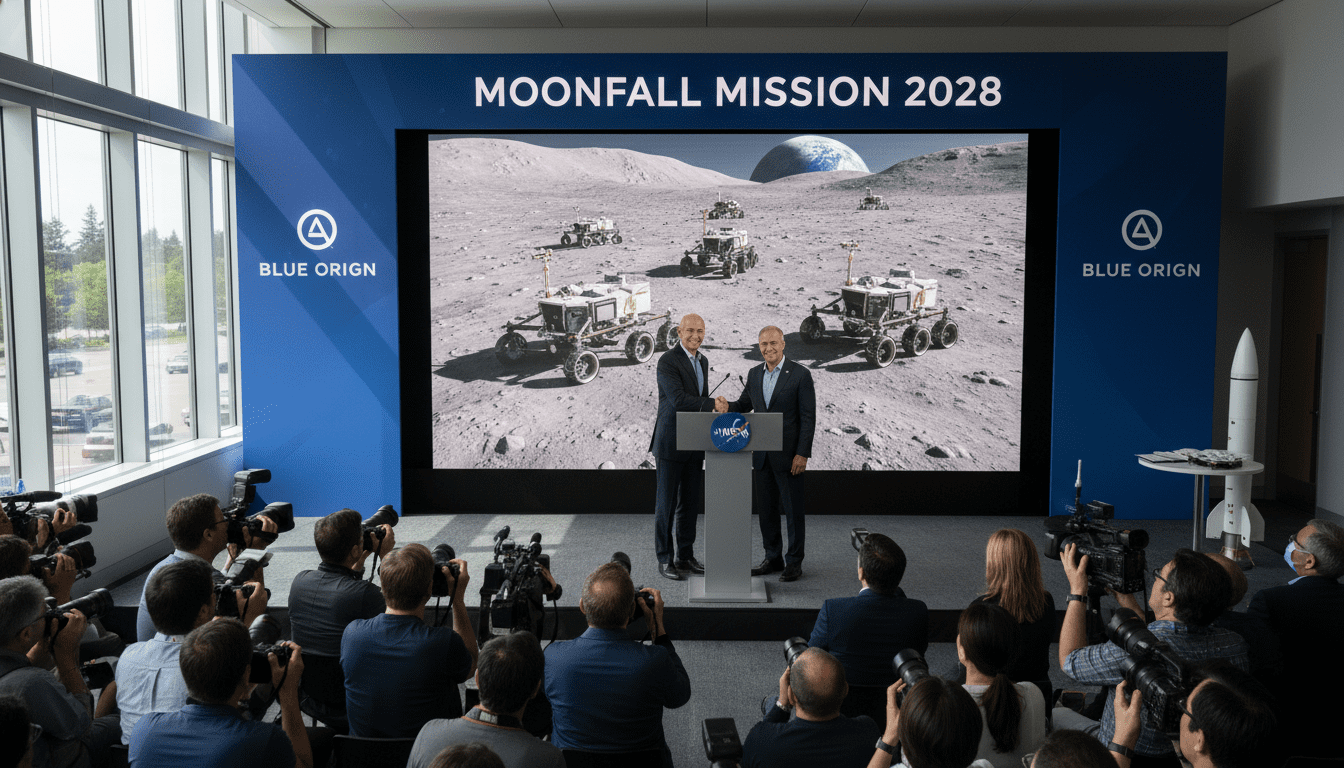
MoonFall mission: Blue Origin wins $188 million contract to deliver lunar rovers
Blue Origin won $188M contract to land rovers on the Moon for the MoonFall mission; Firefly Aerospace will build an orbital lunar drone carrier in 2028.
The MoonFall mission will see Blue Origin transport robotic rovers to the lunar surface after the company secured a $188 million contract to provide a Mark-1 cargo lander for the effort. Officials confirmed that Firefly Aerospace has been selected to build a spacecraft capable of carrying and deploying drones from Earth orbit to the Moon, with the combined effort targeting a 2028 mission. The award marks a significant commercial step in preparing logistics and delivery systems for sustained robotic activity on the Moon.
Blue Origin awarded $188 million contract
Blue Origin received the contract to supply its Mark-1 cargo lander for transporting rovers to predetermined landing sites on the lunar surface. The agreement covers development and integration work required to adapt the Mark-1 for delivering multiple science and exploration payloads safely to the regolith.
The contract amount reflects the scale of the mission’s logistics and the technical modifications expected to meet mission-specific requirements. Procurement officials highlighted that the award follows a competitive selection process focused on payload capacity, descent precision, and surface operations readiness.
Mark-1 lander configured to carry rovers
The Mark-1 cargo lander will act as the final descent and surface delivery vehicle for the rovers assigned to the MoonFall mission. Designed to accommodate modular payload bays, the lander will house the rovers during transit and perform a controlled descent to ensure safe deployment on touchdown.
Engineers will adapt the vehicle’s guidance, navigation, and propulsion systems to match the mission’s targeted landing zones. These modifications are intended to optimize both landing accuracy and the protection of sensitive rover instruments during the high-risk descent phase.
Firefly Aerospace to provide orbital-to-lunar drone carrier
Firefly Aerospace has been contracted to develop an orbital-to-lunar delivery spacecraft that will ferry drone systems from Earth orbit to the Moon. The vehicle’s mission will include transport, transfer maneuvers, and release operations that enable the drones to reach designated lunar insertion trajectories.
The drones themselves are intended to expand surface access and mobility, complementing the rovers’ scientific work by scouting terrain and relaying communications. Firefly’s role underscores growing industry specialization where one company handles lunar descent while another manages orbital transfer and drone deployment.
2028 timetable for launch and operations
Mission planners have set 2028 as the target year for the MoonFall mission’s launch window and operational timeline. The schedule includes remaining development milestones, integrated testing of the Mark-1 lander and Firefly’s transfer vehicle, and a sequence of rehearsals to validate deployment procedures.
Officials noted that meeting the 2028 date will require coordinated progress across suppliers, regulatory approvals, and launch services. Contingencies remain in place to accommodate technical delays, but program leadership emphasizes the importance of maintaining momentum to meet international and commercial partner expectations.
Implications for commercial lunar logistics
The MoonFall mission advances the commercial approach to lunar logistics by combining descent, orbital transfer, and small-drone deployment capabilities. This layered architecture reflects a shift from single-vendor missions to integrated services where multiple private companies contribute distinct but interoperable elements.
A successful mission would strengthen market confidence in repeatable cargo deliveries to the Moon and inform standards for interfaces, landing safety, and payload integration. Industry observers say the outcome could accelerate commercial opportunities for scientific payloads, technology demonstrations, and future sustained robotic presence on the lunar surface.
Regulatory and partnership considerations moving forward
Executing a mission of this complexity requires clearance from national space authorities and coordination with international stakeholders for frequency allocation and orbital trajectories. Program managers will need to secure export controls, safety certifications, and compliance with relevant lunar protection guidelines before hardware launches.
Partnerships with scientific institutions and space agencies are expected to shape final payload manifests and operational concepts. Transparency around mission objectives and data-sharing arrangements will be important for attracting research partners and meeting legal obligations tied to lunar activities.
The MoonFall mission represents a calculated step by commercial actors to establish reliable transport and deployment capabilities on and around the Moon, bringing together Blue Origin’s lander expertise and Firefly Aerospace’s orbital transfer work for a planned 2028 operation.
