
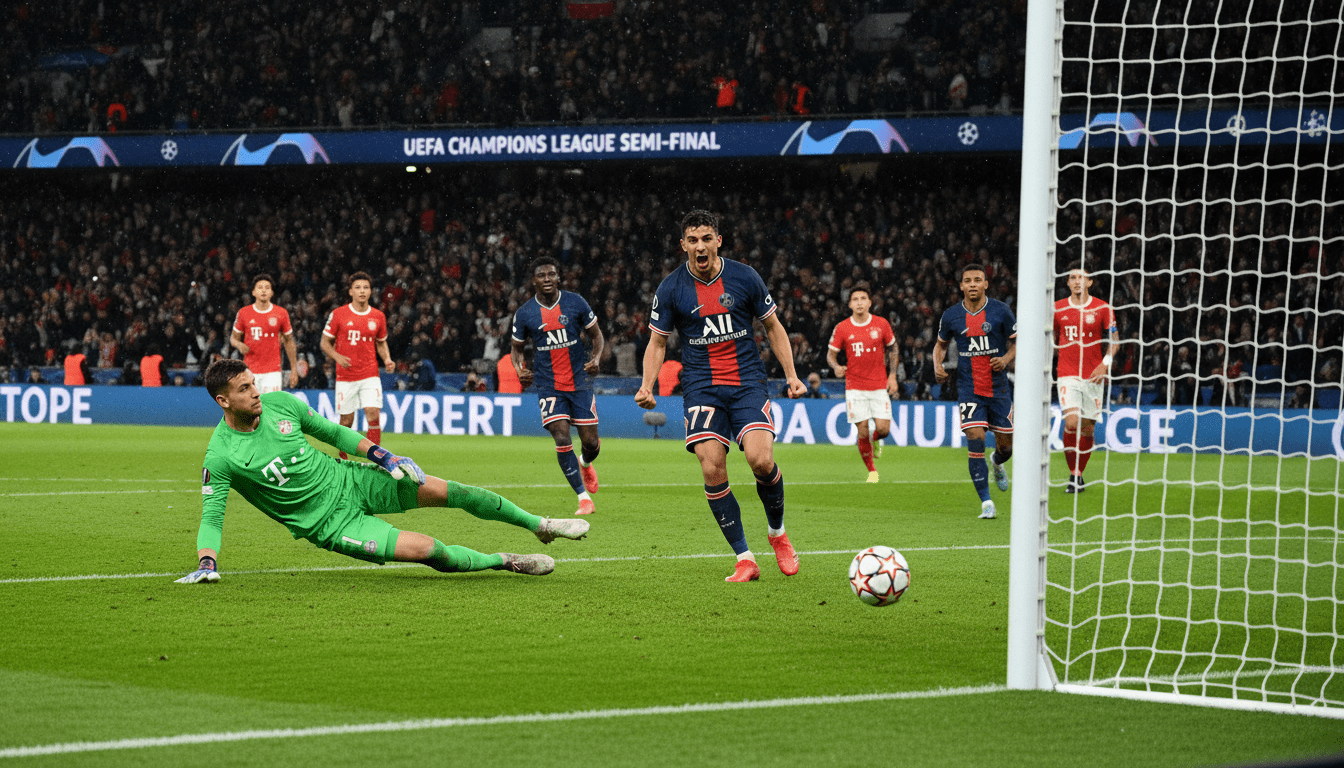
Khvicha Kvaratskhelia’s 23:58 equaliser ignites PSG in Champions League semi first leg
Khvicha Kvaratskhelia’s late equaliser for PSG against Bayern highlighted his dribbling brilliance, Champions League form and the high-profile €70m transfer from Napoli.
Khvicha Kvaratskhelia produced a match-defining moment in the Champions League semi-final first leg at Parc des Princes, turning a brief sequence into a decisive 1:1 equaliser for Paris Saint-Germain. The 25-year-old Georgian’s intervention at 23:58 captured the night’s momentum and crystallised why he is attracting global attention. PSG will head to the second leg with renewed belief after Kvaratskhelia’s composed finish ended Bayern’s lead.
Kvaratskhelia’s Equaliser at 23:58 in Paris
Minute 23:58 became the highlight of a game many supporters will remember for years, as Kvaratskhelia weaved through Bayern’s defence to level the tie. The left flank move began with a midfield pass and finished with a delicate series of touches from the Georgian winger that sent the ball into the far right corner. His reaction was restrained; the goal was met with determination rather than celebration, a sign of a player focused on the next contribution.
The sequence lasted only seconds but underlined Kvaratskhelia’s ability to change a match in an instant. Commentators invoked comparisons — echoes of past greats — but the moment was primarily a statement of his technical skill and timing. It also shifted the tie’s complexion, leaving Bayern with fresh questions to answer in the return leg.
Désiré Doué’s Feed Set Up Kvaratskhelia
The build-up began in midfield, when Désiré Doué threaded a ball behind Bayern right-back Josip Stanisic, exploiting the space left by a defensive shift. Stanisic, drawn out by earlier feints, found himself chasing back toward his own box as the play accelerated. Kvaratskhelia used a compact series of right-footed cuts around the defender before skewing the ball beyond a covering leg and into the net.
Timing was crucial: the move unfolded between 23:50 and 23:58, a brief window in which positioning, pace and composure combined. The finish demonstrated not only dribbling flair but also a refined sense of spatial awareness, converting a transitional pass into a single, defining moment.
From Tbilisi to Napoli to Paris
Born in Tbilisi and the son of a former Azerbaijani international, Kvaratskhelia’s rise has been rapid and geographically diverse. He moved to Napoli in 2022 amid disruptions to the regional game and arrived in Italy as a relatively modest signing, later helping the club to a Serie A title. That breakout season earned him recognition as one of Italy’s most dangerous attackers and significantly raised his profile across Europe.
PSG secured Kvaratskhelia’s services in a €70 million transfer after he spent two-and-a-half intense years in Naples. The move included a reported salary increase and handed him a prominent role at Paris, where expectations and scrutiny are significantly higher than in his previous stops.
Tactical Role and Work Rate under Luis Enrique
At PSG, Kvaratskhelia operates primarily from the left as an inverted right-footed threat, cutting inside to create shooting angles and overload central areas. Coaches at club level have emphasised his willingness to work off the ball and press defensively, traits that fit Luis Enrique’s system requirements. The Spanish coach has praised the player’s energy, and former Napoli coach Luciano Spalletti described his versatility as making him “almost an alien” in terms of positional adaptability.
This willingness to contribute defensively marks a contrast with some of PSG’s previous attacking profiles, and it explains why the club invested heavily to bring him in. His role can shift within a match: from traditional winger to false nine to a more direct attacker, depending on tactical needs.
Comparisons to Maradona and Robben
Nicknames such as “Kvaradona” and “Kvararobben” have followed Kvaratskhelia since his time in Italy, reflecting a mix of admiration and attempt to place him in a lineage of greats. The Maradona reference gestures to Napoli’s storied history and the ecstatic relationship between the city and its creative attackers. The Robben comparison points to the familiar inverted winger move from the flank to the inside channel.
Those parallels are flattering but incomplete: Kvaratskhelia’s game is rooted in relentless repetition, directness and a blend of physical urgency with technical polish. He has been clear in interviews that his footballing idol is Cristiano Ronaldo, and his approach to preparation and finishing reflects a modern attacker shaped by different influences.
Champions League Form and Statistical Edge
The winger’s performances on Europe’s biggest nights have been particularly notable this season. He has scored 18 goals in all competitions, with ten of those coming across 14 Champions League appearances, and contributed seven decisive passes in the campaign. His scoring frequency in European competition, measured in minutes per goal, outstrips his domestic rate, a trend that has made him especially valuable in knockout fixtures.
Those numbers underline a pattern: Kvaratskhelia tends to elevate his output in high-stakes games, delivering moments that swing ties and generate headlines. PSG’s reliance on such decisive contributions will be central to their trajectory in the remainder of the Champions League.
Kvaratskhelia’s rise has been rapid, marked by a €10 million move to Napoli that turned into a €70 million transfer to PSG and a shift from a modest salary to a substantially higher contract. He has adapted to different football cultures, maintained an intense work ethic and produced match-winning interventions on European nights. As PSG prepare for the second leg, Kvaratskhelia’s equaliser stands as both a tactical turning point in the tie and a reminder of how a single player’s brief sequence can reshape a competition.
