
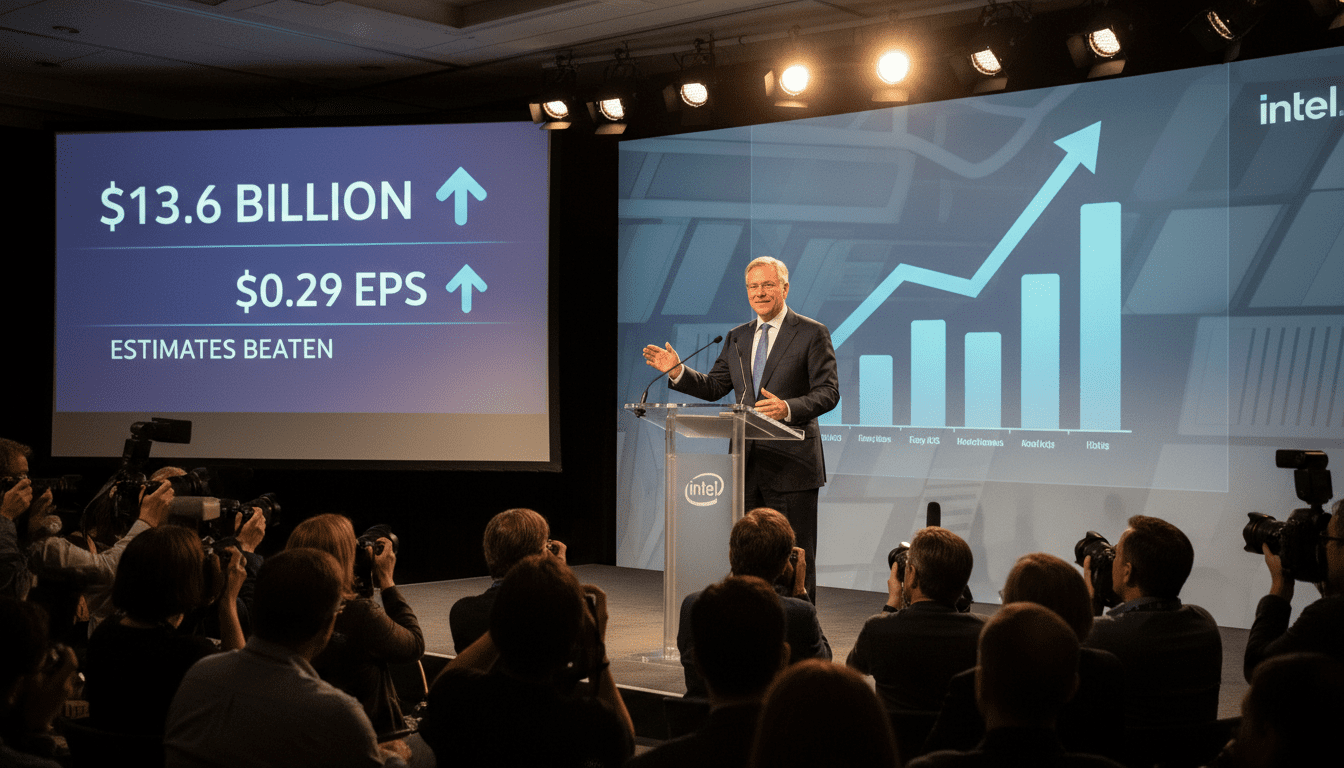
Intel quarterly revenue climbs 7% to $13.6B, far exceeding analyst forecasts
Intel quarterly revenue rose 7% year-on-year to $13.6 billion, beating expectations as adjusted EPS reached $0.29 vs. the $0.01 estimate.
Intel quarterly revenue topped expectations in the most recent reporting period, with the chipmaker posting $13.6 billion in sales, a 7% increase from the prior year. The results included an adjusted earnings per share of $0.29, substantially above the consensus estimate of $0.01 and well ahead of revenue forecasts near $12.4 billion. The stronger-than-anticipated performance marks a notable positive swing for the company after a period of investor scrutiny.
Earnings beat and market surprise
The company’s adjusted profit per share of $0.29 provided an unexpected cushion for investors, turning what many had viewed as a borderline quarter into a clear beat. Revenue of $13.6 billion compared with an average analyst projection of roughly $12.4 billion, underscoring that sales momentum outpaced street models. That gap between results and expectations is likely to reshape near-term estimates as analysts digest the stronger operating performance.
Year-on-year growth and revenue dynamics
A 7% year-over-year increase in revenue signals that core demand drivers improved enough to offset lingering headwinds in parts of the semiconductor market. While the company did not provide a full segment breakdown in the excerpt provided, the overall topline advance suggests a combination of pricing, volume, or product mix gains. Investors will watch upcoming disclosures for details on which product lines and regions contributed most to the advance.
Profit drivers and margin implications
The jump in adjusted earnings per share implies meaningful margin improvement or lower-than-expected costs for the quarter, given that the revenue beat alone may not fully explain the outsized EPS result. A $0.29 adjusted EPS versus a $0.01 consensus indicates either stronger operating leverage, one-time accounting items, or effective cost controls. Market participants will look to management commentary and the company’s reconciliation of non-GAAP items to understand how sustainable those profit levels are going forward.
Leadership visibility and strategy signals
Chief executive Lip-Bu Tan has maintained a visible public profile amid the company’s operational shifts, appearing at industry events and meetings in recent months. Management visibility and public remarks can shape investor confidence during transitional periods for large chipmakers. How leadership frames the drivers of the quarter — whether through recovery in client demand, acceleration in cloud-related spend, or improved manufacturing cadence — will be important for expectations heading into the next reporting cycle.
Investor reaction and analyst adjustments
The combination of a revenue beat and significantly stronger adjusted EPS is likely to prompt analysts to revise near-term estimates, at least until more granular guidance is released. Share-price reaction can be volatile in the hours and days after such surprises, as short-term traders and long-term holders reassess the durability of the improvement. Equity researchers will be particularly focused on updated guidance, margin trajectory, and any commentary about capital spending or product roadmaps.
The latest quarter’s results provide an early signal that Intel quarterly revenue can outpace conservative forecasts, but the company’s path back to consistent growth will depend on sustaining demand, converting product investments into higher-margin sales, and delivering transparent guidance to the market.
