
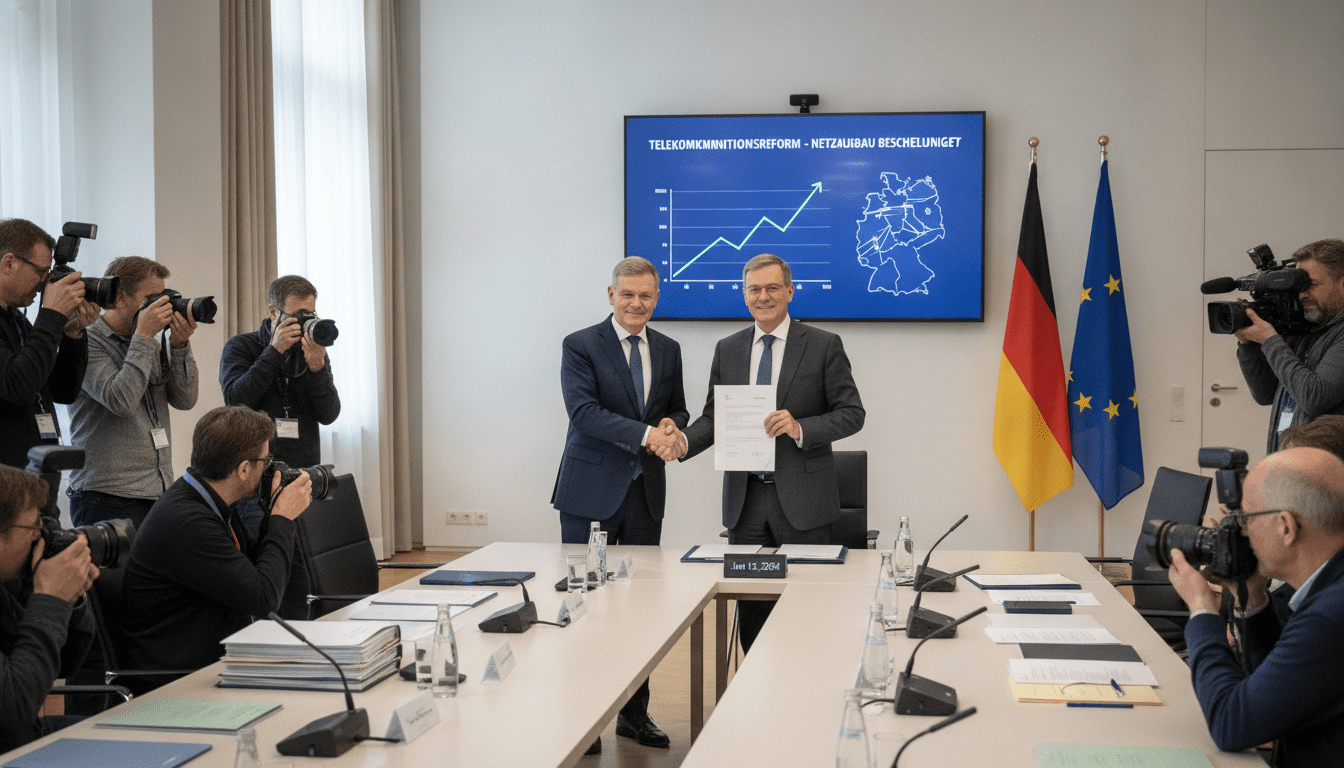
Cabinet Approves Reform to Accelerate Fiber-Optic Expansion to Every Building
Germany’s cabinet has approved a telecoms law reform designed to accelerate fiber-optic expansion, easing building access and granting operators a “right to full build.”
The federal cabinet on Wednesday approved a reform of the Telecommunications Act intended to make investments in the fiber-optic network simpler and faster, with the explicit aim of bringing fiber to every building and every home. The draft bill, championed by Digital Minister Karsten Wildberger (CDU), removes several legal and administrative barriers and will now be considered by the Bundestag and Bundesrat. Officials said the reform is meant to secure fast and stable internet as a prerequisite for economic growth and social welfare in the digital era.
Cabinet backs streamlined permitting to boost fiber-optic expansion
The reform simplifies and shortens approval procedures for laying fiber inside and up to buildings, according to government statements. Ministers framed the changes as measures to unlock private investment and to reduce bureaucratic delays that have stalled deployments in many areas. The draft explicitly targets the frequent situation in which fiber lines currently stop at the building entrance rather than reaching individual apartments.
“Right to full build” changes condominium access rules
A central element of the proposal is a new legal “right to full build” that would allow telecom operators, under defined conditions, to install fiber throughout an entire building. Building owners would only be able to prevent such work if they formally commit to carrying out the same infrastructure build-out themselves. The change is intended to ease expansion in multi-unit buildings and condominium associations by removing the need for unanimous consent from each individual owner.
Non-discriminatory access to internal building networks
The draft also foresees a statutory right of non-discriminatory access to existing in-house cabling, obliging the operator of internal wiring to allow competitors to share the infrastructure in certain cases. The government says this will increase choice for consumers by enabling more providers to offer services in buildings that already have a private cabling system. Officials argued that shared access will reduce duplication of cabling and accelerate activation of connections.
Railway collaboration and other complementary measures
Beyond buildings, the bill would obligate railway companies to support the rapid rollout of mobile networks along rail lines where feasible, shortening deployment timelines for mobile connectivity along routes. The package bundles several technical and regulatory measures meant to make both fixed fiber and mobile network expansion more efficient. Industry and government officials have framed these steps as part of a broader push to modernize Germany’s digital infrastructure.
Funding outlook and 2026 deployment targets
The Digital Ministry previously estimated that the telecommunications sector would invest roughly €8.5 billion in fiber and about €2.4 billion in mobile networks in 2026. Those funds are expected to enable approximately 5.6 million new fiber connections next year, with roughly 3.1 million ready for immediate use. The ministry presented those figures as evidence that regulatory reform combined with private investment can significantly increase coverage and capacity.
Availability versus activation: a persistent gap
Despite expanding physical availability, a substantial gap remains between where fiber can technically be installed and where it is actually activated and used. Mid-2025 data cited by industry associations indicated that fiber access was possible in about 24.3 million households, businesses and public institutions. However, only around 27 percent of theoretically possible connections had been booked and activated by end users, highlighting ongoing challenges in subscription uptake and activation logistics.
The government and industry point to several reasons behind the low take-up rate, including insufficient in-building access, fragmentation of property ownership in apartment blocks, and a lack of consumer awareness or perceived need. Reform proponents say the new legal rights and access rules aim directly at those obstacles by making it easier to extend fiber to individual apartments and to allow multiple providers to serve the same building.
Legislative timetable and next steps
With cabinet approval complete, the draft law now moves to the Bundestag and then the Bundesrat for debate and potential amendment. If passed, the changes would follow Germany’s prior series of TKG reforms and a political framing that treats network expansion as an overriding public interest. Lawmakers and stakeholders will scrutinize technical provisions, conditions for the right to full build, and safeguards for property owners and tenants during the parliamentary process.
Industry groups are expected to press for clarity on operational rules and compensation for shared infrastructure use, while property associations may seek stronger protections for owners who wish to control building works. The final shape of the law will determine how quickly operators can proceed with large-scale in-building deployments and whether the projected 2026 investments translate into substantially higher activation rates.
The cabinet decision represents a significant regulatory shift designed to overcome long-standing structural hurdles to fiber-optic expansion in urban and rural multi-unit buildings. If enacted, the measures could reduce the number of installations that currently stop at the building threshold and increase consumer choice by opening internal networks to competing providers.
