
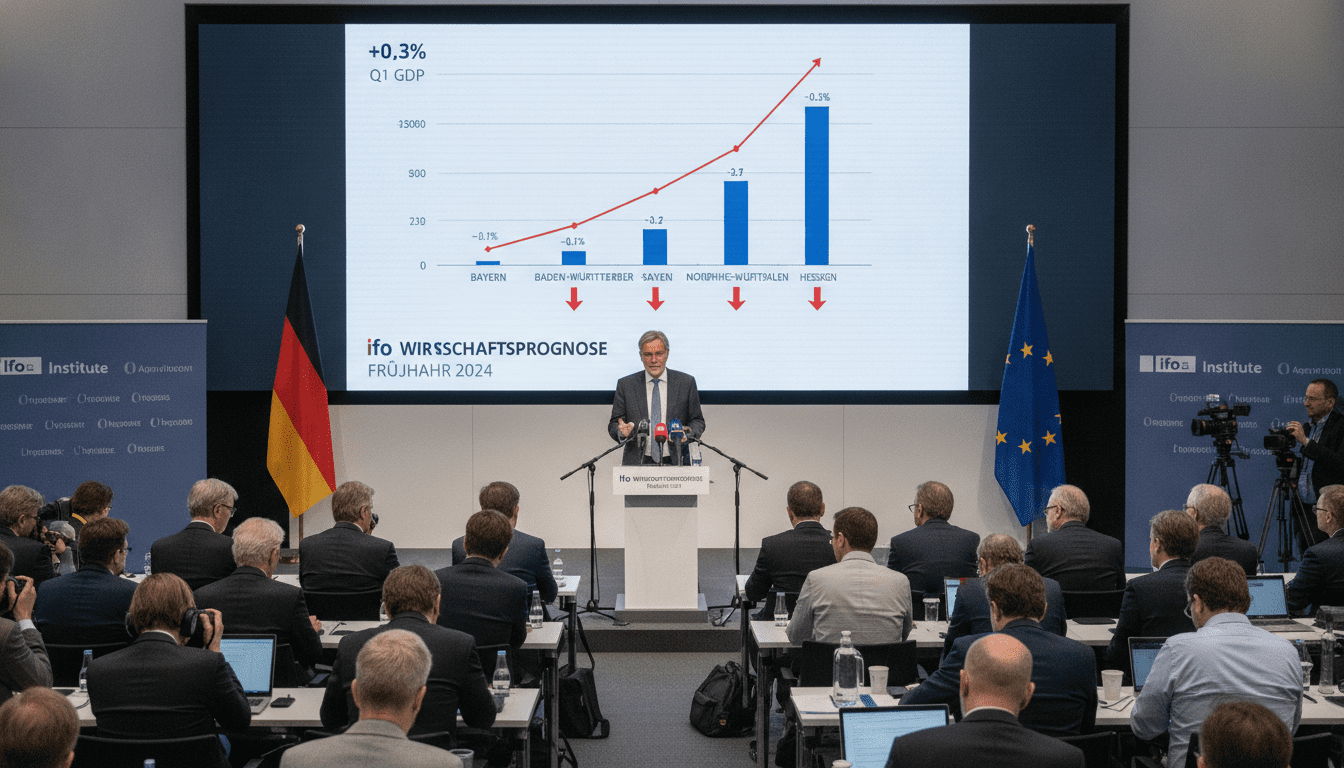
German regional economic growth diverges sharply as only 12 states expand in Q1 2026
Only 12 of 16 states recorded German regional economic growth in Q1 2026; industry mix and high energy costs drove sharp regional disparities and weak exports.
Germany’s economic expansion at the start of 2026 was small but uneven, with the nation posting 0.3 percent growth in the first quarter (January–March 2026) while gains were concentrated in a minority of states. The ifo Institute’s regional breakdown shows 12 of the 16 Bundesländer expanded in Q1 2026, leaving four states in contraction and exposing sharp structural differences across the country. Policymakers and business groups say the divergence reflects local industry mixes, energy cost burdens and pockets of demand tied to defence-sector investment.
Regional Q1 performance at a glance
Berlin and Brandenburg led the quarterly gains with increases of 0.9 percent each, followed by Baden-Württemberg and Rhineland-Palatinate at about 0.8 percent. These positive readings contrast with contractions in several northern and western states, underlining how national headline figures mask pronounced subnational variation. Overall GDP rose 0.3 percent in Q1 2026, but the ifo Institute’s calculations make clear that growth was not evenly distributed across Germany’s federal states.
States experiencing contraction and population exposure
Hamburg and Schleswig-Holstein recorded the largest quarterly declines, each shrinking by 0.5 percent, while Lower Saxony fell by 0.2 percent and North Rhine–Westphalia by 0.1 percent. Taken together, those four states account for more than one-third of Germany’s population, magnifying the social and political consequences of localized downturns. The concentration of population and industrial activity in the contracting states raises risks for employment and municipal finances if negative trends persist.
Industry mix and energy-price pressures
ifo analysts point to the regional distribution of industrial firms as a key driver of the divergent outcomes. Manufacturing started the year strongly overall, but high energy costs are weighing on energy‑intensive producers in some regions, slowing output and investment. Regions with large manufacturing footprints and thin buffers against energy-price shocks were disproportionately affected, while services‑oriented areas or those with lower energy intensity fared better.
Defense procurement lifts some regions
At the same time, areas with a significant defence-industry presence benefited from increased rearmament and defence modernisation spending, according to ifo. Suppliers located in parts of northern and western Germany have seen demand rise as defence procurement accelerates, supporting local growth even as other sectors face headwinds. The uneven distribution of defence-related orders has therefore become an important factor shaping regional winners and losers in the current cycle.
Quarter-to-quarter and year-on-year comparisons
Comparing quarters across the past year shows persistent variation: Bavaria and Berlin each posted about 1.0 percent growth on an annual basis for the period under review, while Schleswig-Holstein was among the weakest on a year‑over‑year basis with a 0.5 percent contraction. Rhineland‑Palatinate stood out for having two consecutive quarters of decline in the July 2025–March 2026 window, registering a 0.1 percent drop in Q3 2025 and a further 0.2 percent in Q4 2025. Conversely, Lower Saxony delivered the strongest single-quarter performance in late 2025, climbing 1.1 percent in the fourth quarter.
Policy implications and outlook for the regions
Economists warn that the pattern of concentrated growth heightens the importance of targeted regional policies, including energy relief for industry, investment incentives and support for workforce transitions. If energy prices remain elevated or global demand softens, regions dependent on energy‑intensive manufacturing could see further downside. On the other hand, ongoing defence investment and pockets of service-sector strength may sustain local expansions, yielding a mixed national outlook.
The ifo Institute’s findings underscore that headline GDP numbers provide only a partial picture of economic health; state-level dynamics matter for jobs, tax revenues and local services. As the year progresses, regional trends will be a key barometer of whether Germany’s modest national growth can broaden beyond a handful of states or whether disparities will deepen, demanding more focused policy responses and business adaptation.
