
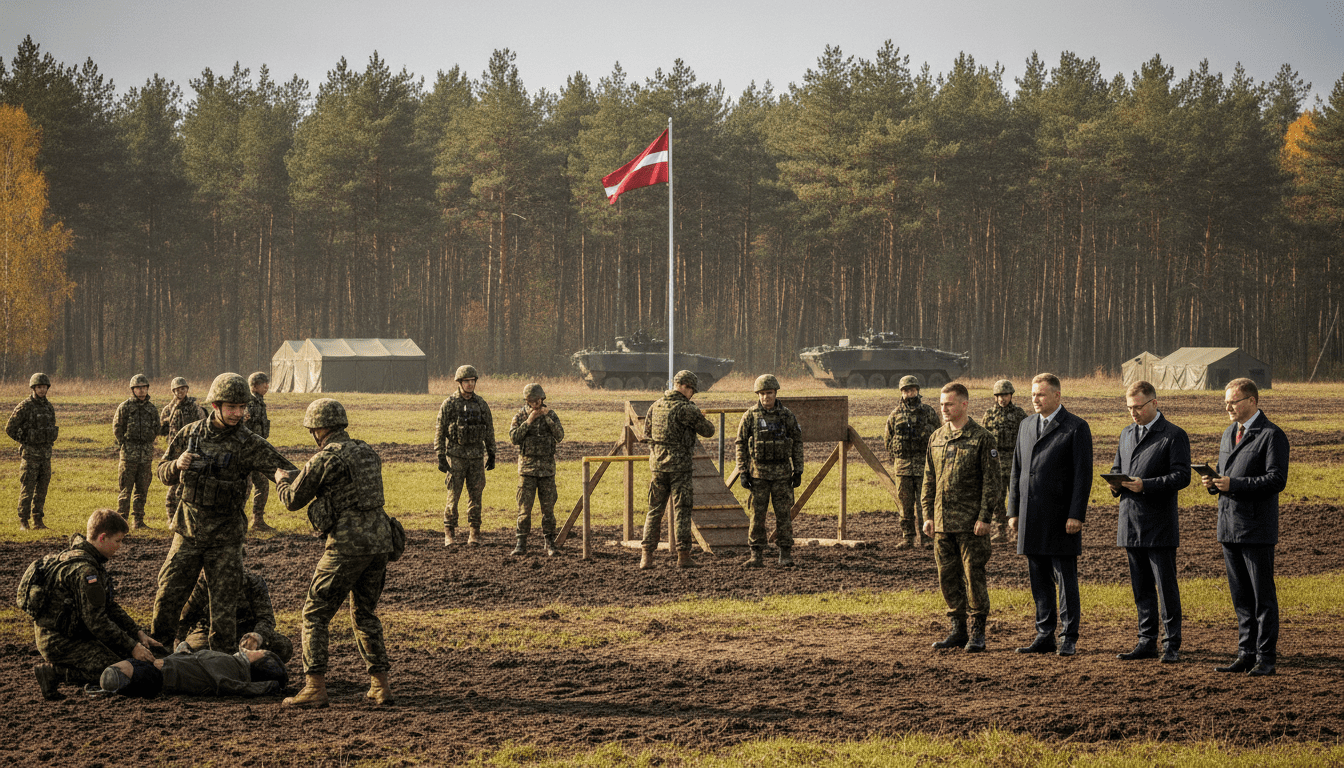
Latvia’s VAM: 16-year-olds on schoolyards learn rifle drills as state defense education becomes mandatory
Latvia’s VAM (Valsts aizsardzības mācība) places defense training at the heart of secondary schooling, with students practising air‑rifle drills and military routines under a program made compulsory in 2024.
Latvian defense education unfolded Monday morning on a Riga schoolyard with unusual calm: a group of 16‑year‑olds lay prone on green mats while air rifles were readied under the watch of instructors. The practical session followed classroom theory and marks the first live‑fire exercise for the class, part of the Valsts aizsardzības mācība (VAM) that has been phased into schools since 2018 and enforced as a requirement for tenth and eleventh graders to graduate since 2024. Trainers gave step‑by‑step commands, students loaded magazines and fired five rounds at close targets as fellow pupils watched in silence.
Shooting exercises introduced as routine school activity
A single trainer guided students through positioning, loading and aiming before ordering controlled single shots at foam targets set ten metres away. For many participants, the firing line was a first: what had once seemed daunting became an exercise in concentration and technique. The air rifles used in VAM are described by instructors as non‑lethal training tools, though visually they resemble service weapons and are treated with strict safety protocols.
Program rollout tied to regional security concerns
Latvia began introducing the state defense education program incrementally after 2018, responding to geopolitical shifts in the region and the annexation of Crimea. Initially presented as a civilian alternative while conscription was suspended, the curriculum was expanded and by 2024 made obligatory for students in the final years of compulsory education. The Ministry of Defence and education authorities framed the move as a measure to build preparedness and civic responsibility among young citizens living close to a state that has recently used force in its neighbourhood.
Curriculum dominated by military skills with a small resilience component
Recent evaluations of the VAM curriculum indicate roughly nine out of ten instructional hours concentrate on military‑style training: marksmanship, marching, basic fieldcraft and even the NATO phonetic alphabet. The remaining sessions address civil resilience topics such as identifying disinformation and preparing a 72‑hour emergency kit. Officials present the balance as pragmatic, saying practical soldiering skills coexist with modules designed to boost individual readiness for crises.
Youth Guard Centre contracts civilian trainers to run lessons
The Jaunsardzes centrs, or Youth Guard Centre, which reports to the Defence Ministry, supplies trainers and oversees the programme’s implementation in schools. Many instructors are young and civilian‑trained rather than career soldiers, having completed specific teaching courses to lead classes. The centre also runs voluntary youth guard groups and has seen rising interest since 2022; its director argues early exposure to defence themes is unavoidable given Latvia’s security environment.
Students show practical interest but mixed ideological effects
Pupils describe a range of responses: some said VAM changed their career thinking, with a student who once planned to work in the arts saying she now considers police, fire service or even military roles. Others remain ambivalent; one 16‑year‑old described ongoing worry about conflict but said daily life is “pretty much okay.” Surveys referenced in the programme’s review show high levels of national pride—three quarters of respondents said they were proud to be Latvian—but evaluators report the course mainly reinforces pre‑existing patriotic sentiment rather than converting pacifist or pro‑Russian youths into supporters of armed defence.
Evaluation highlights limited impact on civic engagement
Analysts assessing VAM conclude that while the course increases familiarity with military routines and can strengthen patriotic feeling where it already exists, its effect on broader civic engagement and long‑term career choices is modest. The review finds the programme does not reliably produce a new generation eager to take up arms, and that shifts in attitudes are more likely among those predisposed to national sentiment. Authorities say the intent is not to militarise youth but to provide competencies that could matter in crises; critics warn the emphasis on military content leaves little room for deeper civic education.
In classrooms and on the schoolyard the programme has settled into a predictable cadence: a day a month of practical training, totalling about 112 hours across the school year, with sessions resuming after the summer break. Instructors conduct formal post‑exercise checks, and pupils perform routine declarations that no equipment has been removed from ranges, underscoring the programme’s insistence on order and safety. As Latvia continues to position VAM as part of national preparedness, debate persists about how best to balance defence skills with broader civic education.
