
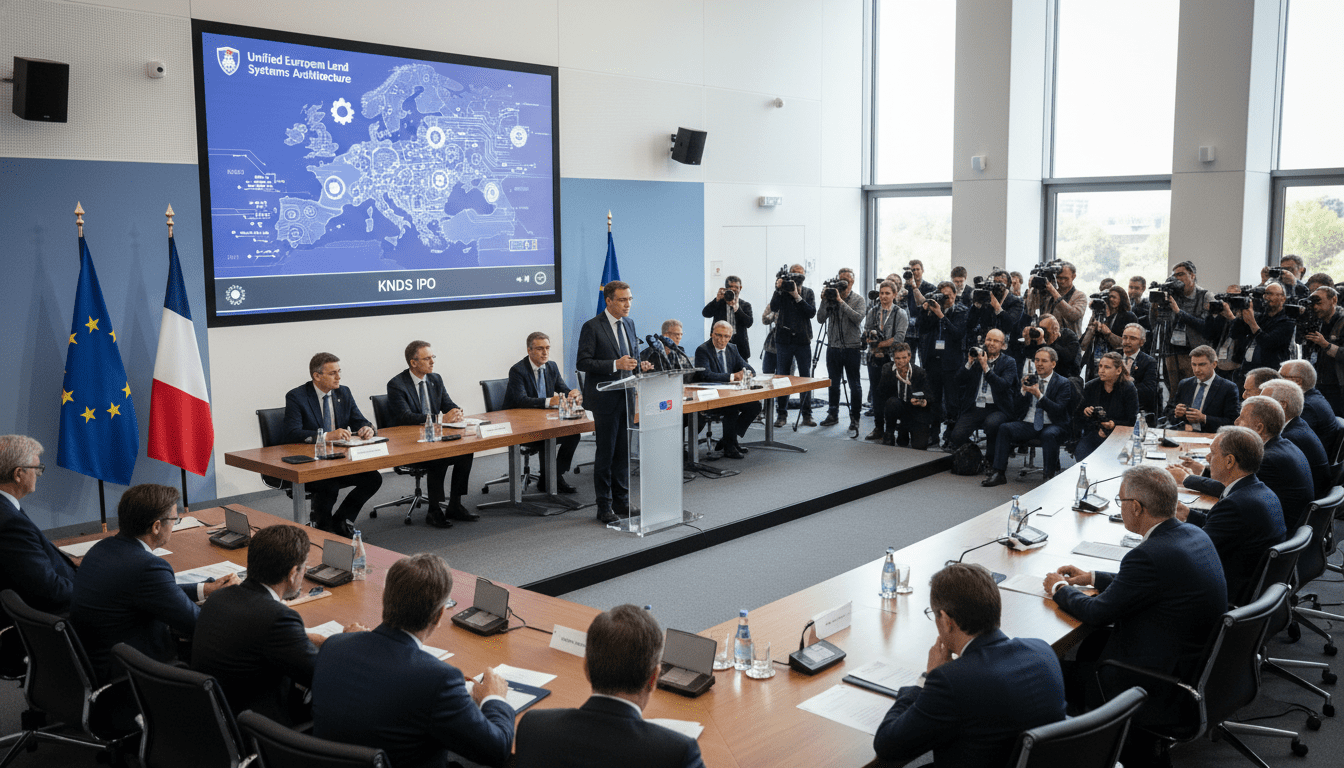
KNDS IPO set for “as soon as possible” after German-French state stake deal
KNDS IPO likely after German and French state stake deal; company reports €4.4bn revenue and plans to standardize European land systems while expanding drone use
KNDS said it will pursue a public listing after Germany and France agreed to mirror stakes in the Franco-German defense group, and CEO Jean-Paul Alary told journalists the KNDS IPO remains a top priority. The planned offering follows a deal in which both states will hold roughly 40 percent of the capital, clearing the path for an initial sale of about 20 percent to investors. Alary also reiterated KNDS’s strategic aim to push a common European baseline architecture for land systems while growing integration with unmanned systems.
State stakes and the path to public markets
Alary confirmed that parity between the German and French governments creates the governance structure intended to enable a market debut, and he said the company will sell an initial tranche of roughly 20 percent to outside investors. He declined to provide a firm date but repeated the company’s goal of listing “this year” and stressed that market conditions will dictate timing. KNDS’s leadership frames the transaction as a step toward broader private participation over time, with oversight arrangements designed to preserve the group’s operational agility.
Governance and future ownership evolution
Tom Enders, chairman of KNDS’s supervisory board, has signaled that the current arrangement — with states holding a large combined stake after an IPO — is likely transitional and that authorities aim to reduce holdings over the long run. Alary pointed to Airbus as a template, where French and German state shares were progressively trimmed to double-digit levels, and said KNDS’s governance must evolve to support commercial development. The CEO declined to comment on media reports about potential minority investments by other defense firms, underscoring that strategic discussions continue.
Financial performance and margin improvement
KNDS posted record results for the latest fiscal year, with revenue rising by nearly 16 percent to €4.4 billion and EBITDA around €660 million, producing an operating margin that Alary reported had climbed to about 15 percent. The rise in sales was driven largely by orders for Leopard 2 battle tanks and other tracked and wheeled platforms, reflecting increased defense budgets across Europe. Management emphasized that improved margins reflect scale gains and a focus on higher-value systems while noting continued investment needs to expand production capacity.
Product focus: land systems and European standardization
The company reiterated its commitment to remaining focused on the land domain, saying KNDS does not plan to move into naval or space markets and intends to deepen its leadership in armored vehicles and artillery systems. Alary argued that a common, modular baseline architecture for weapons systems across Europe would deliver benefits in interoperability, industrial scale and competition, with national variations limited to localized adaptations. KNDS portrayed itself as a test case for consolidation in an industry that historically produced largely bespoke platforms.
Integration of drones and battlefield connectivity
Responding to lessons from recent conflicts, KNDS is accelerating efforts to connect unmanned aerial systems with manned platforms and fire-control networks, and Alary highlighted existing integrations such as Boxer compatibility with drone systems and reconnaissance drones feeding artillery aiming systems. The company said it plans further partnerships and internal development to couple autonomy, sensors and effectors, stressing that integrated systems should be commanded as a single suite rather than competing components. At the same time, Alary cautioned against seeing drones as a total replacement for armored formations where ground forces remain essential for major maneuvers.
Capacity expansion and industrial footprint
To meet growing order books KNDS is expanding headcount and facilities and searching for additional production capacity, and the company is reported to be in talks about acquiring a plant in Ludwigsfelde near Berlin that would add hundreds of jobs. Management said it prefers capacity increases that combine organic growth with targeted facility acquisitions to accelerate output while preserving supply-chain resilience. The push to enlarge manufacturing capability reflects both existing program obligations and plans to scale for future, standardized European programs.
KNDS’s stated strategy positions the group to capitalize on rising defense spending in Europe while using a state-backed IPO to secure capital for expansion, but executives emphasize that the timing of a public debut will hinge on market conditions and governance outcomes. The company intends to remain a focused land-systems leader, deepen drone and networked-weapon integrations, and pursue industrial scale that supports a pan-European baseline architecture for armored platforms.
