
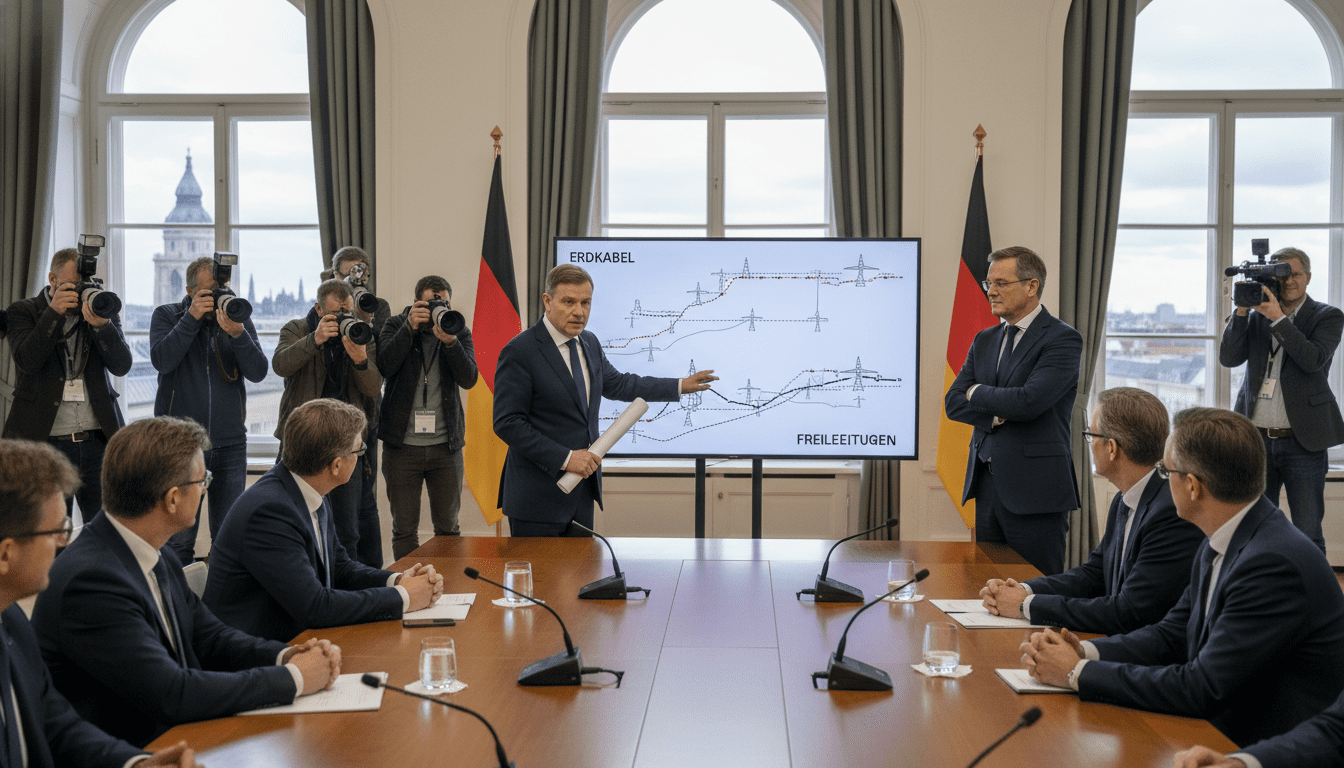
Germany reopens debate on overhead power lines after cabinet moves to end underground-cable priority
Germany’s cabinet approved ending the underground-cable priority, reviving debate over overhead power lines amid cost warnings, local resistance, timing risk.
Germany’s government has reignited a contentious national debate by approving changes to the Bundesbedarfsplangesetz that would lift the 11‑year priority for underground cables and open the door for new overhead power lines. The decision, presented as a cost-saving measure by the federal economy ministry, has prompted sharp reactions from network operators, regional politicians and civic groups. The policy shift centers on whether the country’s next generation of “power highways” will be buried out of sight or carried on towering pylons across large swaths of the country.
Cabinet approves change to federal needs law
The cabinet under Chancellor Friedrich Merz signed off on an amendment to the federal needs planning law that removes the firm preference for Erdkabel, the underground high‑voltage cables that have dominated German planning since 2015. The reform was framed by Economy Minister Katherina Reiche as a step to make the energy transition more cost‑efficient by allowing overhead routing for long transmission corridors. The text adopted by cabinet, however, contains modifications from the ministry’s original draft that critics say dilute the clarity of the policy shift.
Network operators warn of mixed signals and delays
Senior managers in the transmission sector have reacted with caution, saying the law as passed could reintroduce uncertainty and procedural complexity rather than speed up construction. Werner Götz, chief executive of Transnet BW, told industry outlets that changes introduced before the cabinet vote weaken the government’s initial directive to favor overhead solutions. Network operators say the new requirement for detailed cost‑comparison studies and the possibility of mixed routing on the same corridor could spawn local disputes and legal challenges that slow projects.
Cost comparisons remain focal point of argument
Supporters of overhead power lines stress the potential for substantial savings. Industry figures cited by operators claim underground cables are at least twice as expensive as overhead lines, with some estimates putting the multiple even higher depending on terrain and technical requirements. For large projects such as the planned Sued‑West‑Link, Transnet BW has estimated a high single‑digit billion euro price tag for a freestanding overhead route and roughly ten billion euros more if built as a continuous underground line. Opponents point to recent analyses, including a Frontier Economics study partly funded by cable manufacturers, which suggest the long‑term cost advantage of overhead lines may be smaller than traditionally assumed.
Opposition in northern states and parliamentary resistance
The move has provoked strong pushback from northern states, particularly Schleswig‑Holstein and Lower Saxony, which would host substantial sections of any new north–south corridors. Local leaders and activists say overhead masts would scar landscapes and aggravate resistance to renewable projects already seen in the region. Prominent SPD energy politician Nina Scheer and other parliamentarians have defended the case for underground options, arguing environmental, landscape and social factors must carry weight in planning decisions ahead of any wholesale shift back to pylons.
Sued‑West‑Link highlights practical implications
The dispute has immediate relevance for the Sued‑West‑Link, a planned roughly 750‑kilometre direct‑current connection intended to carry wind power from northern Germany to consumption centers in Baden‑Württemberg and Bavaria. Project partners Transnet BW, TenneT and 50Hertz have yet to set a firm construction start date, and current schedules foresee completion no earlier than 2037. Operators caution that an unclear legal signal could complicate stakeholder engagement and permitting on the ground, risking lengthy debates over whether particular segments should be buried or built as overhead lines.
Security, repairs and public acceptance divide experts
Arguments over overhead power lines also touch on questions of security and maintenance. Proponents of underground cables invoke protection against sabotage and visual intrusion, while critics point out that many buried cables sit at relatively shallow depths, can be vulnerable to targeted damage and are more complex and costly to repair. Transnet BW argues public acceptance is not simply a function of aesthetics: underground routing can spark intense opposition from landowners and farmers who resist trenching and prolonged construction on their property. That contested picture, industry leaders say, underlines why a uniform national rule is politically fraught.
The law now faces parliamentary debate and possible amendment in the Bundestag, where lawmakers will weigh technical, fiscal and social considerations. While the government frames the change as a way to curb the rising cost of network expansion — sector estimates place required investment in interregional transmission up to roughly €392 billion through 2045 — the final legal text and subsequent implementing regulations will determine how broadly overhead power lines are used. Stakeholders on all sides say timing and clarity will be decisive for whether major projects can proceed without protracted local opposition or litigation.
The coming months are likely to see intensified negotiations among federal ministries, transmission companies and state governments, with political bargaining shaping both the scale of overhead construction and the safeguards for communities. How the Bundestag resolves those tensions will determine whether Germany accelerates network build‑out through more overhead routes, maintains a mixed approach, or reaffirms the underground priority that has guided planning for the past decade.
