
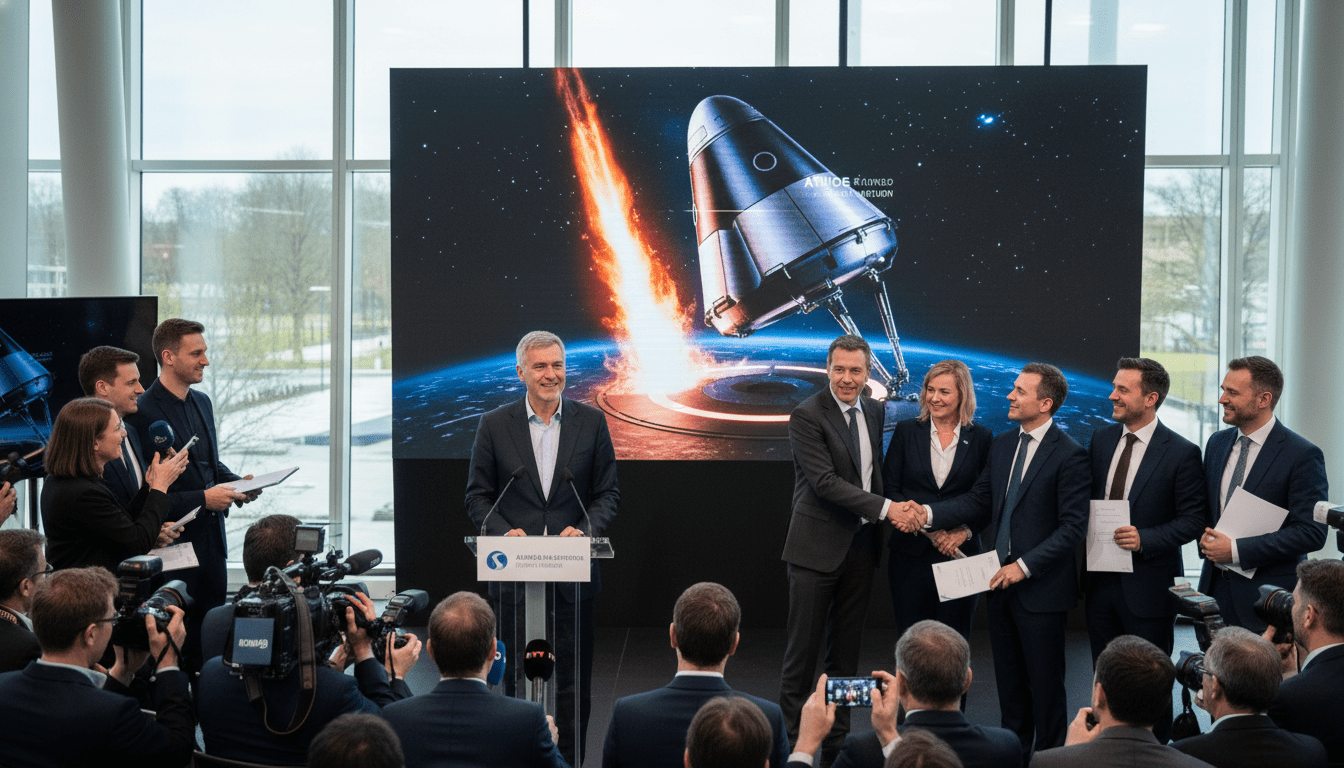
Atmos funding round oversubscribed after startup proves ability to return cargo from space
Atmos funding round oversubscribed as the Lichtenau–Strasbourg startup, first in Europe to return cargo from space, raised more capital than planned and turned down additional offers.
Atmos, the Franco-German space startup, announced an oversubscribed funding round after demonstrating an ability to return payloads from orbit, a capability that has attracted unusually high investor interest. The company, headquartered in Lichtenau in Baden and Strasbourg in France, said the round exceeded its target and that it declined further offers because demand outstripped its planned capital needs. Atmos funding was the central driver of investor attention, industry contacts said, as the firm moves to scale a reentry and recovery service that no other European company has yet delivered.
Funding Oversubscribed
Atmos received investment offers well beyond the amount it sought, according to company statements, prompting the startup to limit the round to what it judged necessary for the next phase. Co‑founder and CEO Sebastian Klaus described the response as stronger than expected, noting the firm had to turn down excess capital. Investors cited the firm’s proven reentry capability and a clear commercial pathway as the main reasons for the rush to participate.
Investor interest was concentrated among venture funds focused on space technologies, as well as strategic corporate investors with logistics and aerospace portfolios. Market observers said the oversubscription underscores growing appetite for services that close the loop on Earth–space logistics, especially for high-value cargo and time-sensitive scientific samples.
First European Cargo Return Capability
What sets Atmos apart and fuels the Atmos funding story is its operational ability to bring freight from space back to Earth. The company has developed a reentry system that protects payloads during descent and enables controlled recovery, a technical milestone few startups reach. That capability positions Atmos as the first European firm to operationalize cargo return at a commercial scale, giving it a potential head start in an emerging market.
Reentry and recovery remain complex and capital‑intensive undertakings, requiring not only thermal protection and structures but also precise navigation, ground recovery logistics, and regulatory approvals. Atmos’s achievement has drawn attention precisely because it reduces a major barrier for customers that need to retrieve hardware, biological samples, or manufactured goods produced in microgravity.
Technology and Manufacturing
Atmos’s hardware centers on a heatshield and reentry vehicle architecture designed to survive extreme temperatures while minimizing mass and cost. Company engineers have focused on repeatability and manufacturability to enable frequent flights and recoveries. The startup also operates development facilities in Baden and engineering teams in Strasbourg, combining German manufacturing know‑how with cross‑border systems integration.
The firm is investing in streamlining production and in end‑to‑end mission control capabilities, including trajectory planning and recovery coordination. Atmos funding will likely accelerate these efforts, allowing the company to move from demonstration flights to regular commercial missions more rapidly.
Planned Use of Funds
Atmos officials said the new capital will be allocated toward scaling operations, expanding manufacturing capacity, and accelerating certification efforts required by aviation and space regulators. The company also plans to bolster its ground recovery network to support multiple landing sites and quicker turnaround between missions. A portion of the funds is earmarked for talent recruitment in engineering and operations to sustain higher cadence missions.
Management emphasized a conservative approach to capital deployment; despite the oversubscription, Atmos opted not to raise beyond its stated needs to avoid unnecessary dilution and to preserve a clear runway toward commercial contracts. That restraint was highlighted by Klaus as a deliberate choice to maintain control over development timelines and technological priorities.
Market Demand and Applications
Demand for cargo return services spans several sectors that could drive Atmos’s commercial growth. Satellite manufacturers seek a way to retrieve and repair delicate components, research institutions require rapid transport of biological samples, and advanced‑materials companies are exploring in‑space manufacturing with Earth return of finished goods. Atmos’s capability to provide reliable, timely returns addresses these specific commercial pain points.
Customers often prioritize short transit times and secure handling; Atmos is pitching its service on speed, predictability, and the ability to recover high‑value or time‑sensitive payloads. Analysts say that while launch remains commoditized, return logistics are an underdeveloped market with high barriers to entry, making early movers potentially influential in shaping demand and industry standards.
Regulatory and Operational Roadmap
To scale, Atmos must secure operational approvals from aviation and space authorities across Europe and potential international recovery partners. The company is already engaging with regulators on testing and certification pathways, and it plans incremental demonstrations to validate safety and reliability. Establishing robust recovery operations on the ground will be critical to convert technical demonstrations into repeatable commercial missions.
Operationally, Atmos is preparing to expand its mission cadence and to offer tailored service levels for different payload types. That requires integrating contracts with launch providers, insurance arrangements, and logistical partners for rapid retrieval and processing once payloads reach Earth.
The oversubscribed Atmos funding round reinforces investor confidence in companies that close the loop on space logistics, but execution risks remain as the firm scales. Atmos has signaled a deliberate, measured use of proceeds aimed at turning its demonstration successes into a sustainable commercial service.
Atmos now faces the task of translating investor momentum into operational milestones, with a focus on certification, manufacturing scale‑up, and customer contracts that will define its next stage of growth.
